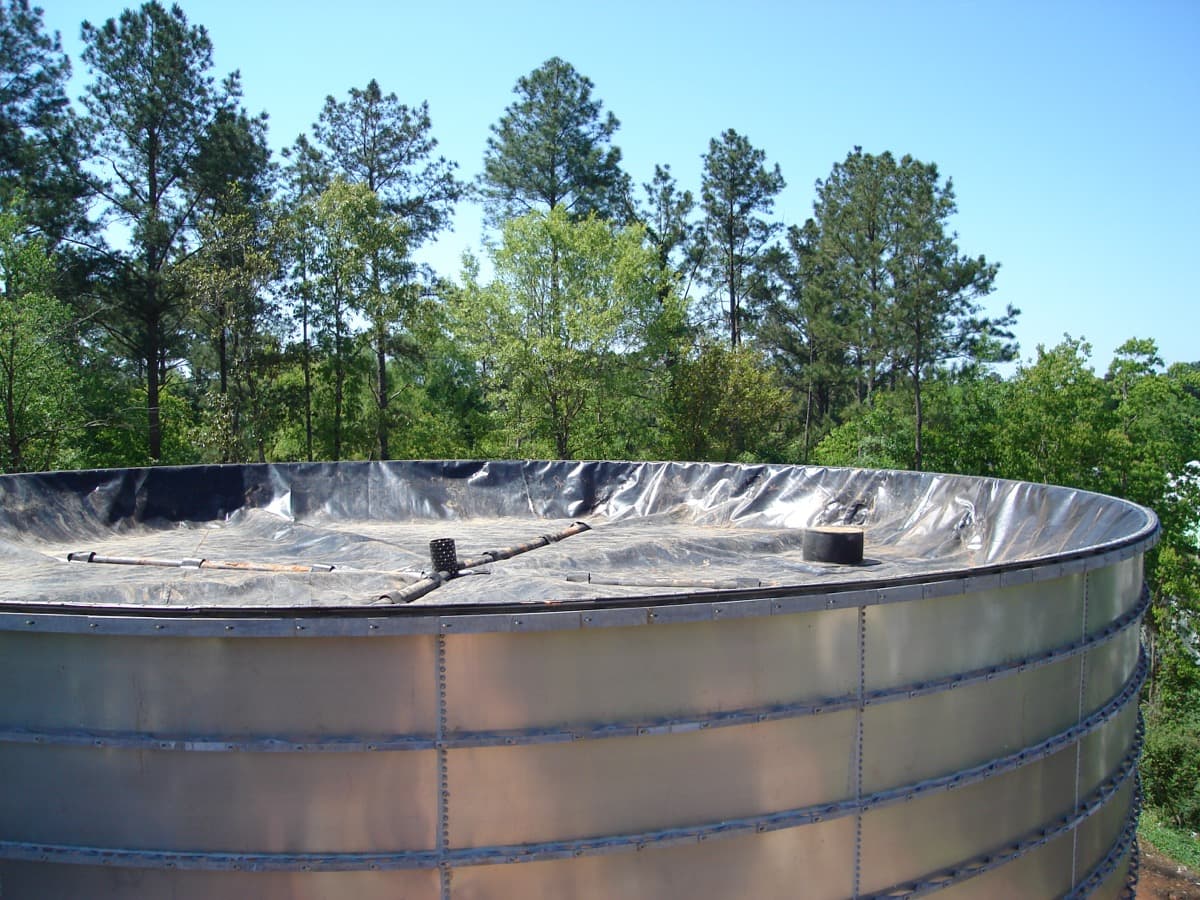
Wastewater lagoons are designed to provide a specific hydraulic retention time (HRT) for biological treatment. In theory, water entering the lagoon travels through the entire volume before reaching the outlet. In practice, short-circuiting -- where influent flows directly from inlet to outlet without fully mixing -- is one of the most common and costly problems in lagoon treatment systems. Baffle curtains solve this problem.
EFI USA designs and installs baffle curtain systems for municipal, industrial, and agricultural lagoons. Our curtain systems are engineered using the same geosynthetic materials and installation expertise that we bring to liner and cover projects, ensuring long-term durability in demanding wastewater environments.
The Short-Circuiting Problem
In an unbaffled rectangular lagoon, tracer studies consistently show that a significant fraction of the influent reaches the outlet in a fraction of the theoretical retention time. Wind-driven currents, thermal stratification, and inlet/outlet placement all contribute to preferential flow paths that bypass the majority of the lagoon volume. The result is that actual treatment performance is far below what the lagoon volume should provide.
Studies of unbaffled lagoons typically show effective retention times of only 30-50% of theoretical HRT. This means a lagoon designed for 30-day retention may actually provide only 10-15 days of effective treatment for a significant portion of the flow.
How Baffle Curtains Work
Baffle curtains are flexible geomembrane panels suspended vertically across the lagoon width, creating a serpentine flow path that forces water to travel the full length of the lagoon multiple times before reaching the outlet. This eliminates short-circuiting and ensures that all water receives the full design retention time.
- Material: Reinforced polypropylene (RPP) or HDPE geomembrane, typically 30-45 mil, with UV stabilization for exposed applications.
- Suspension: Curtains are suspended from surface floats and weighted at the bottom with ballast chain or concrete weights. The bottom edge extends to within 6-12 inches of the lagoon floor.
- Configuration: Typically 2-4 curtains creating a 3-5 pass flow path. The number of passes depends on the lagoon geometry and treatment objectives.
- Openings: Each curtain alternates between left-side and right-side openings, forcing flow to traverse the full lagoon width at each pass.
- Anchoring: Curtain ends are secured to the lagoon embankment using anchor plates or cable systems that allow for water level fluctuation.
Treatment Performance Improvements
Properly designed baffle curtain systems consistently deliver measurable improvements in lagoon treatment performance:
- Effective HRT increase: From 30-50% of theoretical to 80-90%+ of theoretical retention time.
- BOD removal: 15-30% improvement in BOD removal efficiency for the same lagoon volume.
- TSS reduction: Improved settling performance from reduced turbulence in baffled cells.
- Nutrient removal: Enhanced nitrogen removal through improved nitrification/denitrification cycling in serial flow cells.
- Pathogen reduction: Increased actual contact time improves UV inactivation and natural die-off of pathogens.
- Chlorine contact: For disinfection applications, baffled contact chambers ensure regulatory contact time requirements are met with less chemical use.
Applications
Baffle curtains are used across a range of lagoon treatment applications. Municipal wastewater lagoons install baffles to meet tightening discharge limits without building additional treatment cells. Industrial facilities use baffled lagoons to achieve consistent treatment of high-strength waste. Agricultural operations benefit from improved nutrient removal in polishing lagoons. Chlorine contact chambers at water treatment plants use baffles to ensure minimum contact time for disinfection compliance.
Cost and Installation
Baffle curtain installation is significantly less expensive than building additional lagoon capacity to achieve the same treatment improvement. A typical baffle curtain system for a 2-5 acre lagoon costs $50,000 to $150,000 installed -- a fraction of the $500,000 to $2M+ cost of constructing a new treatment cell. Installation can typically be completed in 1-2 weeks without taking the lagoon offline.
“Baffles are the lowest-cost upgrade available for underperforming lagoon treatment systems. You are not adding capacity -- you are using the capacity you already have.”
-- EFI USA Technical Team
Contact EFI for a hydraulic analysis of your lagoon system and a baffle curtain design recommendation. We provide turnkey engineering, fabrication, and installation services.