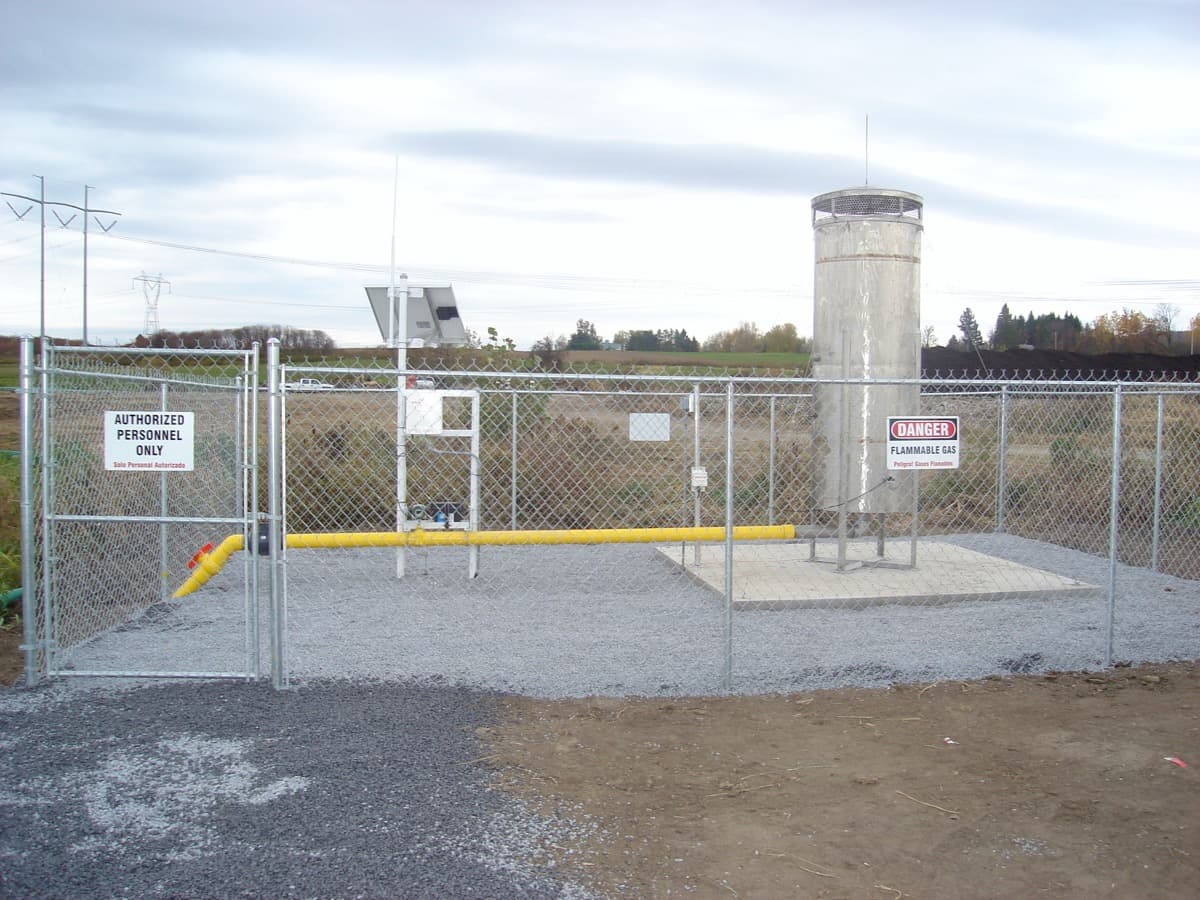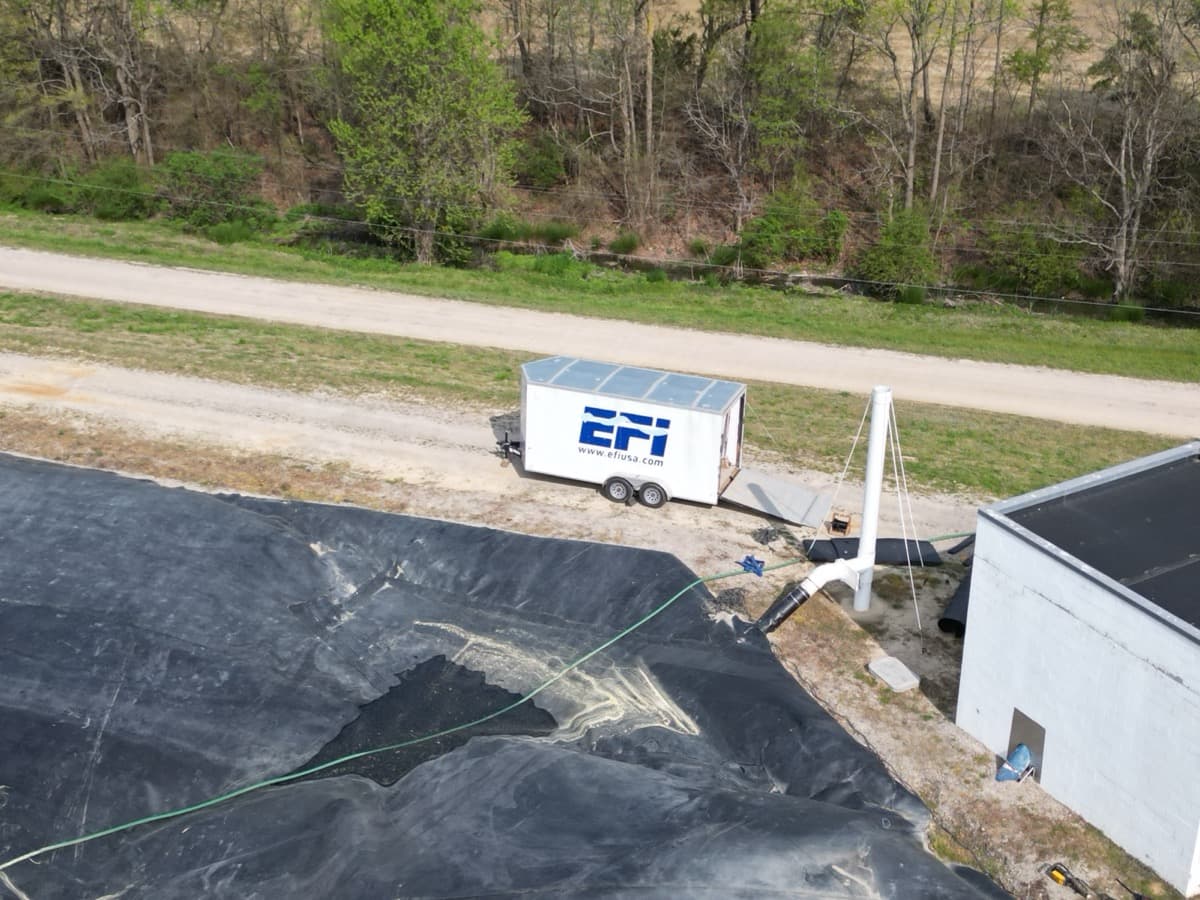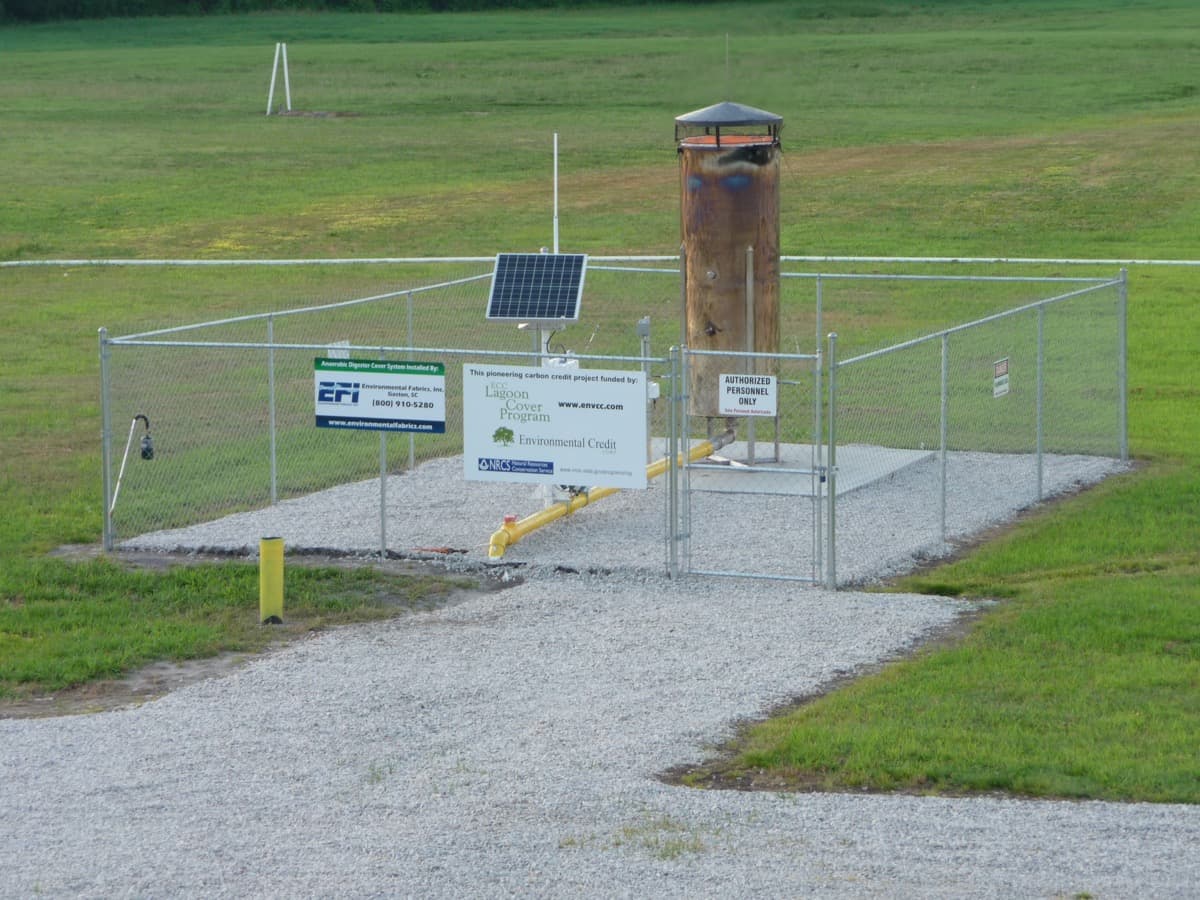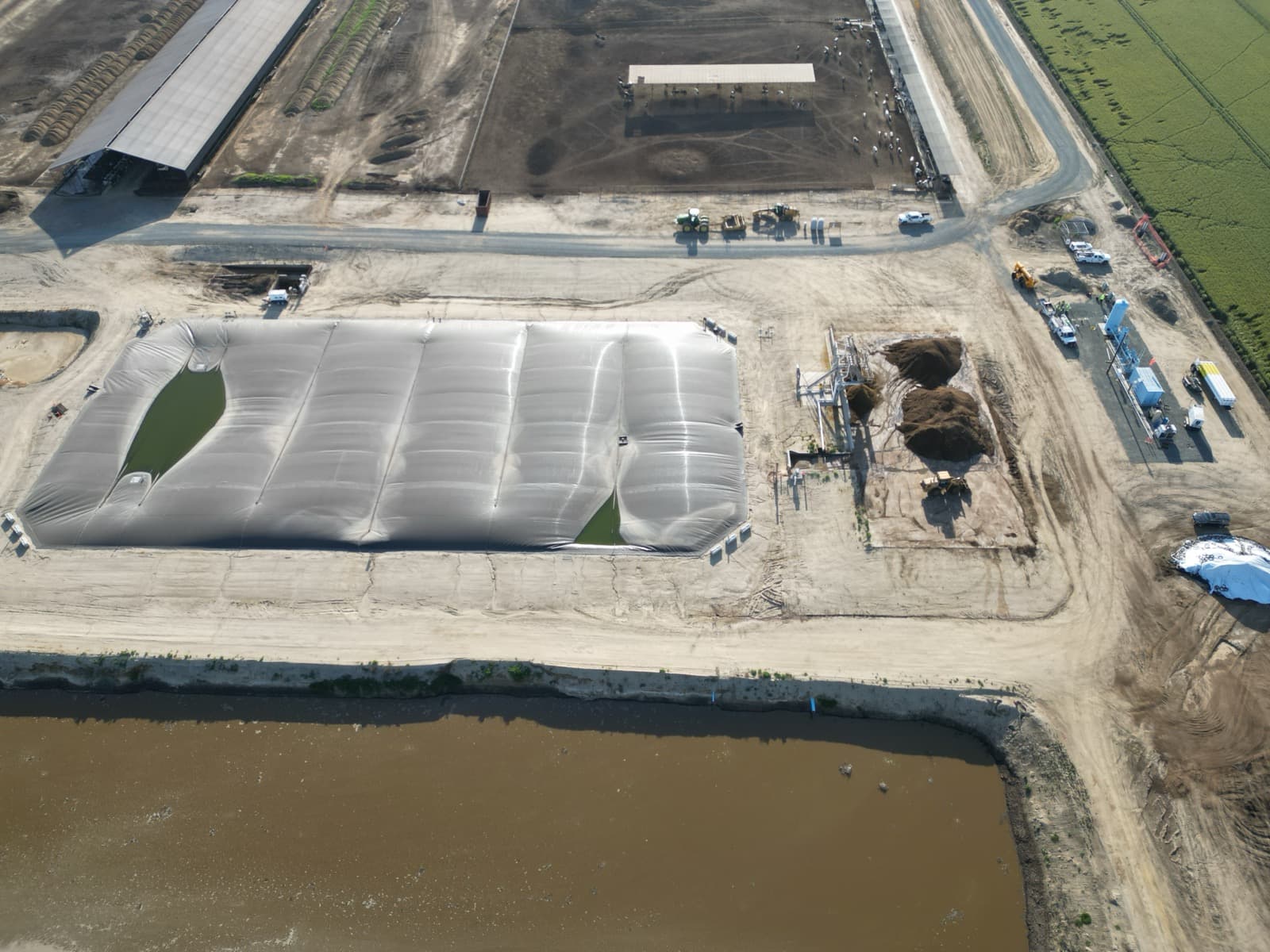
On the agricultural lagoon closures EFI has run, the sludge layer commonly measures 20 to 40 percent of the basin's total volume. That figure surprises owners nearly every time, because nothing about an operating lagoon announces it. An open basin at least gives you a surface to survey and a freeboard to read. Put a floating gas-tight cover over that same basin and the last unobstructed look anyone gets at the bottom is the day the cover goes on.
Sludge accumulation is the slowest failure mode a covered lagoon digester has. It sets off no alarm and it does not show up as a leak, a torn seam, or a pressure excursion. It shows up years later as gas production that has drifted down with no biological explanation, and by the time the drift is obvious enough to investigate, the correction is a construction project rather than an operating adjustment.
What actually settles out
Anaerobic digestion removes volatile solids. It does not remove anything else. Grit, sand from freestall bedding, soil tracked in off the alleys, struvite, and the lignin-bound fiber that bacteria cannot break down all arrive with the waste stream and then stay. The biology has no path for them. They go to the floor and they compact.
Feedstock sets the rate. A dairy on sand bedding builds a sludge layer faster than almost any other operation EFI works with, because the bedding itself is the inert load. Operations that recover sand upstream slow it considerably. Food processing lagoons vary widely depending on whether the plant screens and grit-removes before discharge, which is a decision made inside the plant and often not shared with whoever is responsible for the lagoon.
Distribution matters as much as quantity. Sludge does not lay down in an even blanket. Solids drop where velocity drops, which puts the deepest deposit near the inlet and along the flow path, frequently in the part of the basin that is hardest to reach from the perimeter. A single sounding taken from the bank gives you one data point in the shallowest part of the deposit and tells you almost nothing about the deep end.
The cover changes the measurement problem first
On an open lagoon, a sludge survey is routine work. A crew runs a grid from a boat with a sludge judge or a sonar unit and comes back with a contour. None of that is available under a gas-tight cover. You cannot float a boat on the water, and walking survey equipment across a floating membrane is a good way to damage the asset you are trying to protect while breathing an atmosphere that is more than half methane.
So measurement has to happen through whatever access already exists. Sealed survey ports, existing pipe penetrations, or hatches detailed for the purpose. If the cover was built without any of that, the honest answer to how much sludge is in the basin is that nobody knows, and estimates based on design loading and years in service carry wide error bars.
Then it changes the removal problem
The best case is a basin that was built with dedicated sludge transfer piping run to the low point and brought out through a sealed penetration. Removal becomes a pumping operation. The cover stays sealed, gas collection keeps running, the digester stays in service, and the work is scheduled rather than forced.
Without that piping, removal means opening the cover. Ballast comes off, panels are folded back or cut and rewelded in the field, and the gas collection system comes down for the duration. Every field weld is a seam made in wind and dust rather than in a controlled fabrication environment, and the perimeter and penetration detailing has to be restored to the same standard it started at. The cover is the most expensive component on the basin, and this approach puts it in the middle of a dirty operation.
There is a second risk that gets underestimated. Most of these basins are lined. A dredge cutterhead or an aggressive agitator working a lined lagoon will find the liner, and a puncture at the bottom of a full basin is a far worse problem than the sludge was. Any removal contractor working an EFI-lined lagoon should know the liner type, the depth, and the standoff they are expected to hold before equipment goes in the water.
“The lagoons that are cheapest to desludge are the ones where somebody thought about desludging before the cover went on. That decision gets made once, at construction, and it sets the cost of every removal for the life of the cover.”
-- EFI USA
What to build in, and what can be added later
On new covered lagoon work, four items belong in the design regardless of how far off the first removal looks. Sludge transfer piping to the deepest zone. Sealed penetrations detailed for gas-tight service rather than adapted from a containment detail. Survey ports positioned along the flow path rather than only at the bank. And a mixing system, which keeps a meaningful fraction of the settleable material in suspension where the bacteria can still work on it and pushes the first mechanical removal out by years.
For a basin already in service with none of that, the retrofit is real work but it is bounded work. Adding a survey port or a sludge draw penetration to an existing gas-tight cover is a detailing and welding job, done during a planned outage, on a schedule the operation chooses. That is a different situation from a full drawdown on a basin nobody has looked into in a decade.
Where this leaves an owner
If gas yield is trending down while feedstock volume and composition have held steady, treat it as a volume question before treating it as a biology question. Retention time is volume divided by flow, and sludge takes volume out of the numerator without any other symptom. Chasing the biology on a basin that has lost a third of its working depth wastes a season.
The first question to ask is when the basin was last surveyed. If the answer is that it never has been, that is the finding, and it is worth acting on before the next drop in production makes the timing someone else's decision.
EFI has built more than 500 covered lagoon digester systems since 1993 and works across roughly 82 percent of the US covered lagoon market, including retrofits to covers EFI did not originally install. If the access was never designed in, it can usually be added, and it is worth doing on a planned outage rather than under the pressure of a basin that has already lost its retention time.