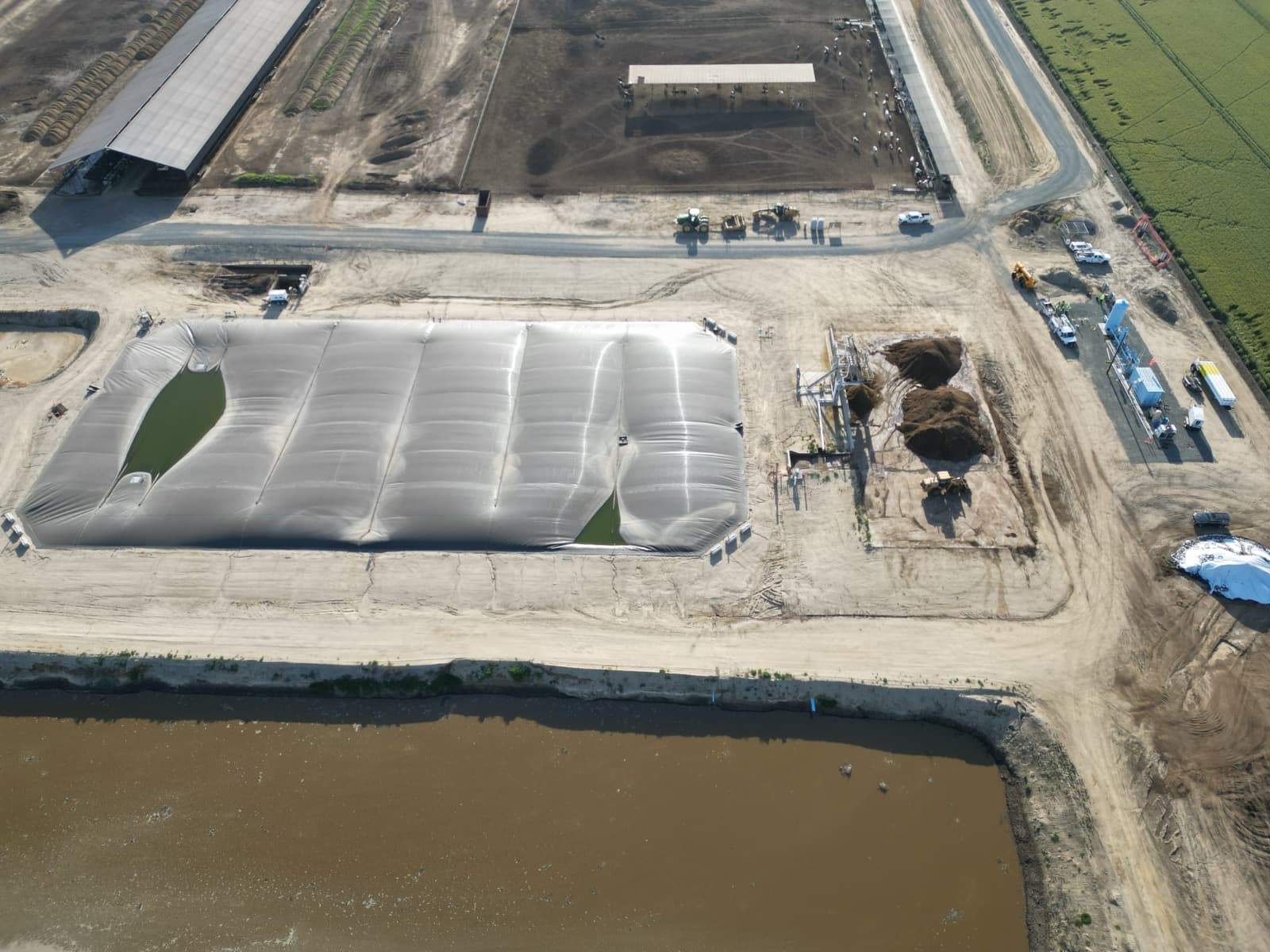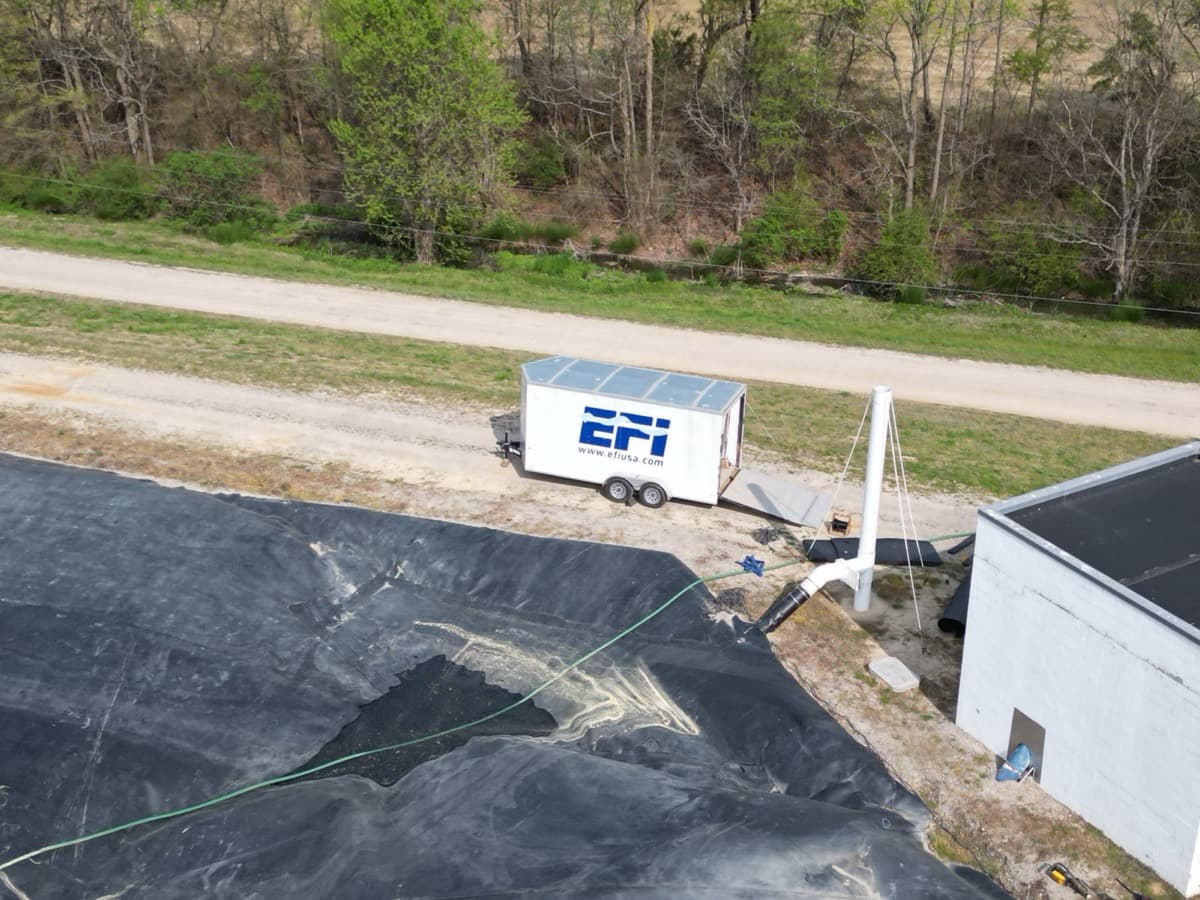
The H2S treatment on a micro-aerated covered lagoon is not a piece of equipment. It is a bacterial film growing on the underside of the cover and on the inside of the gas collection piping. It does not appear on an equipment list, no one has ever seen it, and it is the only thing between the sulfide in the basin and the flare. Every operating decision that touches those two surfaces touches the treatment.
That matters because the film can be lost, and it is lost asymmetrically. Sulfate reduction in the basin does not pause when a blower trips. Sulfide keeps forming at the rate it formed the day before. Only the oxidation stops. The gas number climbs at the rate the basin generates and it comes back down at the rate bacteria grow, and those two rates are nothing alike.
How fast the gas number moves
Take a one acre cover with roughly two feet of gas space beneath it. That is about 85,000 cubic feet of headspace. A basin making 100,000 standard cubic feet of biogas a day turns that volume over about once a day. Whatever the film was removing yesterday is out of the system within a shift or two, and the reading at the flare is close to raw sulfide by the second day.
At 3,000 ppm, that same basin carries about 25 pounds of sulfur a day out of the water. Micro-aeration holding 2 to 4 percent oxygen in the headspace keeps the outlet under 200 ppm, and on most EFI installations under 50. Lose the film and the whole 25 pounds a day goes back downstream, into a flare tip, a blower, and a media bed that were all sized on treated gas.
What actually resets the population
Four events do it, and only one of them is a failure. The other three are scheduled work that nobody thinks of as touching gas quality.
- An interruption to the air feed. A tripped blower, a plugged filter, a frozen line, or a controller left in hand after a service call. The mechanical fault gets cleared in an afternoon and the gas quality does not follow it back on the same schedule.
- A cover replacement. The film leaves the site with the old cover. The new one goes in clean, and colonization starts over once oxygen is reintroduced.
- A drawdown or a large sludge and scum removal campaign. The headspace and liquid interface is where the oxidation happens, and stripping it removes a large share of the working surface along with the solids.
- A sustained temperature drop. Cold slows the oxidizers before it slows the sulfate reducers, so the gap opens from both ends at once in a hard winter.
The part that surprises owners
The first gas readings after any of those four events are not a verdict on the equipment. On a cover replacement in particular, the sequence is a new cover, a clean gas system, and an H2S number that looks worse than the one the old cover was producing on its last day. The reflex is to question the new cover or the injection skid. The actual answer is that the population colonizes surfaces within days of oxygen introduction and nothing has been wrong at any point.
Restarts after a long air outage behave the same way. Judging either one on day one produces a wrong conclusion, and the wrong conclusion usually leads somebody to raise the oxygen dose past what the population can consume. That puts free oxygen into the biogas, which is a safety and gas quality problem in its own right and does nothing to speed up the biology.
Designing so the gap stays short
Redundancy on the air side is worth more than headroom on it. A second blower is a small line item next to a flare tip, an engine service interval, or a month of media replacement on a scrubber that was never sized to see raw gas. The failure that matters is not a blower running below capacity. It is a blower not running at all.
Alarm on air flow, not only on outlet H2S. Air flow is the leading indicator and H2S is the lagging one, and the delay between them is the whole headspace turnover. A site alarming only on gas quality finds out about a Friday night blower trip on Monday, and by then it has already sent two days of untreated gas to whatever is downstream.
Record the outlet number before any planned outage. Without a documented pre-outage baseline there is no way to tell a recovering population from a system that needs retuning, and the argument about which one it is tends to outlast the recovery itself.
What this means for an owner
Treat an air feed outage as a gas quality event with a tail rather than a maintenance ticket that closes when the motor turns. Schedule cover replacements and sludge campaigns with a treated gas gap written into the plan, and tell whoever takes the gas before it shows up on their analyzer. If the offtake has a hard sulfur specification, that conversation has to happen while the work is still on paper.
EFI has built covered lagoon and digester systems since 1993 out of Gaston, South Carolina, with more than 500 systems in service and roughly 82 percent of the US covered lagoon digester market. Remote monitoring comes standard on our O2 injection installations for exactly this reason. The gas number tells you what the biology did last night. Nothing else on the site does.