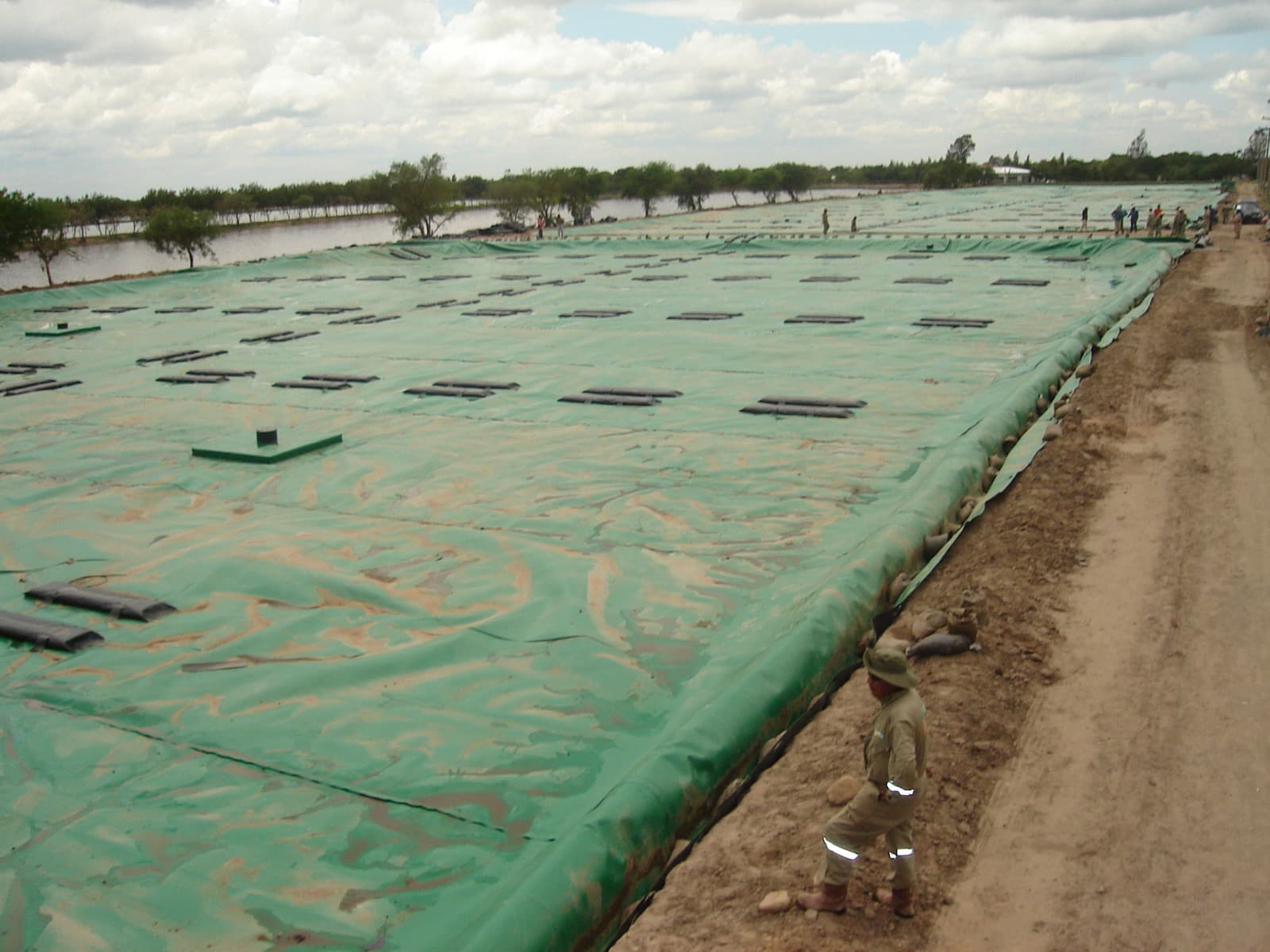
Covered lagoon digesters are designed as passive systems -- no heating, no external mixing, no mechanical agitation. The anaerobic digestion process in a CLD relies on the natural thermal stratification and convective mixing that occurs within the lagoon. This simplicity is a core advantage of CLD technology: fewer mechanical components means lower maintenance costs, higher reliability, and longer system life. But there is a meaningful performance gap between a completely passive CLD and one with properly designed mixing, and that gap translates directly to biogas production and carbon credit revenue.
Why Mixing Matters in Covered Lagoon Digesters
Anaerobic digestion requires contact between organic matter (the substrate) and the methanogenic bacteria that convert it to methane. In an unmixed CLD, this contact relies on diffusion and natural convection -- processes that are slow and incomplete. Incoming waste tends to form channels through the lagoon, bypassing large volumes of untreated substrate. Sludge accumulates on the lagoon floor, sequestering organic matter that could produce biogas. Temperature stratification creates warm upper zones with active digestion and cold bottom zones with minimal biological activity.
Mixing addresses all three problems. By circulating the lagoon contents, mixing distributes incoming substrate throughout the active volume, resuspends settled sludge to make it available for digestion, and reduces temperature stratification so that a larger fraction of the lagoon volume operates at temperatures conducive to methane production. The result, documented in both research literature and EFI's field data, is a 20-40% increase in biogas production compared to unmixed CLDs of the same size receiving the same waste stream.
Mixer Types for Covered Lagoon Digesters
EFI's white paper on mixers for covered lagoon digesters evaluates three primary mixing technologies, each with distinct advantages and limitations for CLD applications.
Mechanical Mixers
Mechanical mixers -- typically submersible propeller or hyperboloid designs -- provide the most direct and controllable mixing energy. They can be sized precisely for the lagoon volume and substrate characteristics, and mixing intensity can be adjusted by varying motor speed or operating schedule. The disadvantages in CLD applications are significant: mechanical mixers require power connections through or around the cover, create potential leak points in the cover membrane, and demand periodic maintenance that requires diver access or cover removal. For large CLDs (surface areas above 100,000 square feet), multiple mixers may be needed, multiplying both the cost and the maintenance burden.
Jet Mixing Systems
Jet mixing uses pumps located outside the lagoon to recirculate lagoon contents through nozzles that create high-velocity jets within the lagoon. The pump and motor are accessible on the lagoon bank, eliminating the need for cover penetrations for electrical connections and simplifying maintenance access. Jet nozzles can be installed through the lagoon wall or through the cover with relatively simple sealed penetrations. The disadvantage is that jet mixing provides less uniform mixing than mechanical mixers, with mixing intensity decreasing rapidly with distance from the nozzle.
Recirculation Mixing
Recirculation mixing draws lagoon contents from one location and reintroduces them at another, creating bulk flow patterns that mix the lagoon contents over time. This approach uses standard pumps and piping, requires minimal cover modifications, and can be designed to draw from the sludge layer and discharge into the active zone, effectively managing sludge accumulation while providing mixing. The mixing intensity is lower than mechanical or jet systems, but for CLDs where the primary goal is sludge management and moderate mixing improvement, recirculation may provide the best cost-to-benefit ratio.
Design Considerations
Mixer selection for a CLD depends on lagoon geometry (depth, surface area, length-to-width ratio), substrate characteristics (total solids, volatile solids, fiber content), temperature range (which affects viscosity and biological kinetics), and the cover system design (which constrains penetration locations and maintenance access). EFI's design process evaluates these factors for each project to recommend the mixing technology and configuration that provides the target performance improvement at the lowest lifecycle cost.
- Lagoon depth: deeper lagoons (15+ feet) benefit more from mixing because thermal stratification is more pronounced
- Substrate solids content: high-solids waste streams (above 5% TS) benefit more from mixing because settling and channeling are more severe
- Cover type: impermeable gas-tight covers require sealed penetrations for any equipment that passes through the membrane
- Climate: cold-climate installations benefit more from mixing because thermal stratification suppresses biological activity in unmixed bottom layers
- Carbon credit revenue: the incremental biogas production from mixing must generate sufficient additional carbon credit revenue to justify the mixer capital and operating costs
Field Data: Mixer Installations and Replacements
EFI's 2025 pipeline includes two mixer-specific projects that illustrate the ongoing lifecycle management of mixing systems. The Caballero mixer replacement addressed an aging mechanical mixer that had reached end of life after years of continuous operation in a corrosive biogas environment. The replacement included updated motor and propeller assemblies, new electrical penetration seals, and improved mounting hardware designed for easier future maintenance access.
The Diamond H mixer assembly project involved installing a new mixing system on an existing CLD that had been operating without mixing. Pre-installation biogas production data from the Diamond H system will provide a direct before-and-after comparison of mixing impact on gas production. This type of controlled comparison -- same lagoon, same waste stream, same cover system, with and without mixing -- provides the most reliable field data on mixing effectiveness.
Sludge Management: The Secondary Benefit
Beyond biogas production improvement, mixing provides a critical secondary benefit: sludge management. Sludge accumulation is the single biggest threat to long-term CLD performance. As inorganic solids, undegraded fiber, and settled organic matter accumulate on the lagoon floor, the effective lagoon volume decreases. A CLD designed for 60-day hydraulic retention time may effectively operate at 40-day HRT after 10 years of sludge accumulation, reducing treatment performance and biogas production.
Mixing keeps settled solids in suspension, exposing them to biological degradation and preventing the dense, compacted sludge layer that is expensive to remove. Operations with active mixing systems typically defer mechanical sludge removal by 5-10 years compared to unmixed systems. At sludge removal costs of $100,000-$500,000 per event (depending on lagoon size and sludge volume), the mixing system's sludge management benefit alone can justify its installation cost.
Cost-Benefit Analysis
A mixing system for a typical dairy CLD costs $30,000-$80,000 installed, with annual operating costs of $5,000-$15,000 (primarily electricity). If mixing increases biogas production by 25% on a system generating $200,000 annually in carbon credits, the incremental revenue is $50,000 per year. The mixer pays for itself in 1-2 years and generates positive net revenue for the remainder of its 10-15 year service life.
Add the sludge management benefit -- deferring a $200,000 sludge removal event by 5-7 years -- and the economic case becomes even stronger. EFI recommends mixing systems for most new CLD installations where the incremental biogas production and sludge management benefits justify the added complexity. For existing unmixed CLDs with documented underperformance, retrofit mixing is one of the highest-ROI upgrades available.
“A covered lagoon without mixing works. A covered lagoon with proper mixing works 25-40% better. For the cost of a mixer system, you get more gas, more credits, and you push sludge removal out by years. It is the easiest ROI calculation in the business.”
-- EFI USA