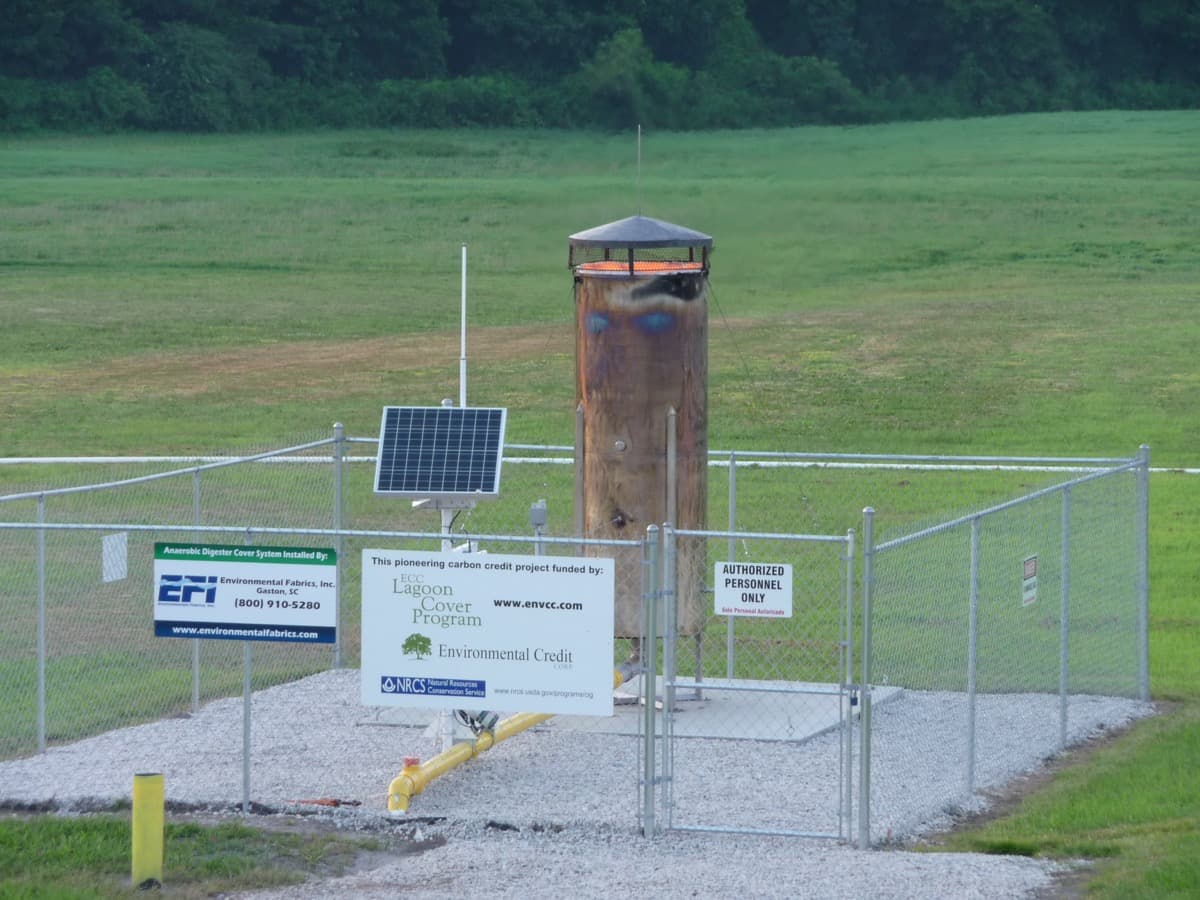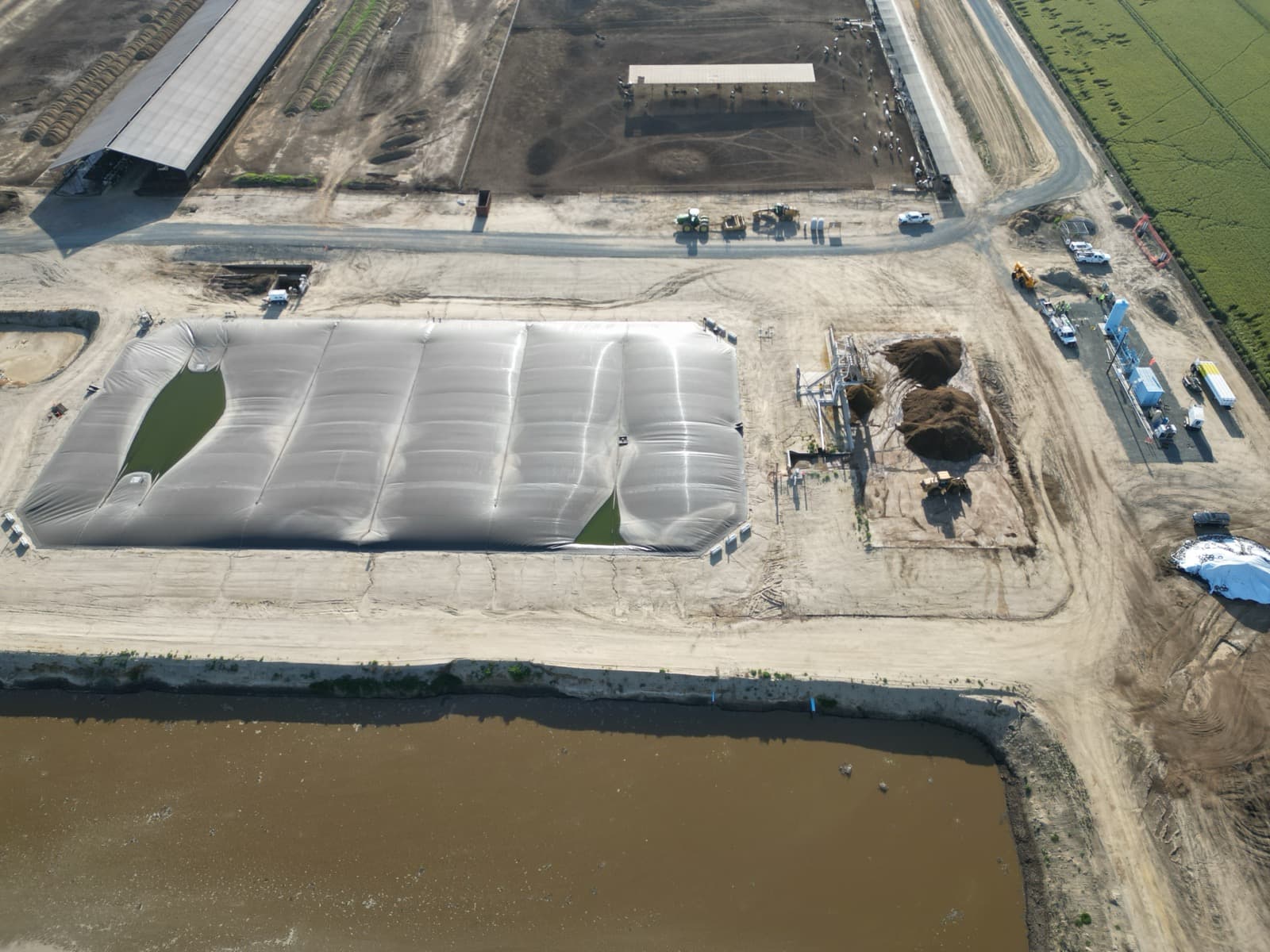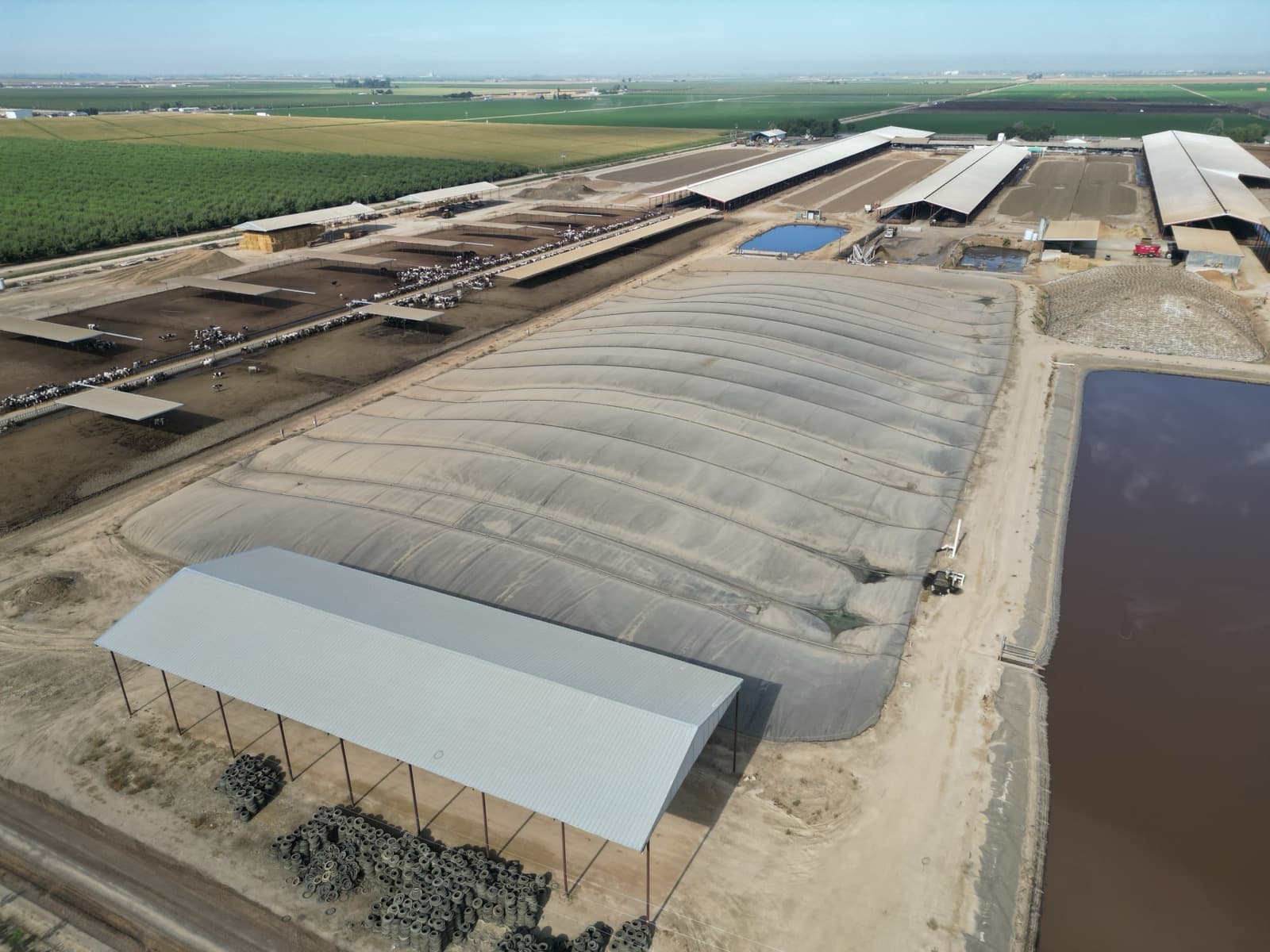
A covered lagoon digester (CLD) is an anaerobic digestion system that captures biogas from existing wastewater lagoons by installing a geosynthetic cover over the lagoon surface. Unlike more complex reactor-based systems, a CLD works with the lagoon infrastructure you already have, making it the lowest-cost entry point into biogas capture and methane destruction.
EFI USA has installed more than 500 covered lagoon digester systems across the United States, representing approximately 82% of the domestic CLD market. That experience has given us an unmatched understanding of what works, what fails, and how to design systems that perform reliably for decades.
How a Covered Lagoon Digester Works
The principle behind a CLD is straightforward. Organic waste in a lagoon decomposes anaerobically (without oxygen), producing biogas -- a mixture of methane (CH4), carbon dioxide (CO2), and trace gases including hydrogen sulfide (H2S). In an uncovered lagoon, this biogas escapes directly into the atmosphere. Methane is roughly 80 times more potent than CO2 as a greenhouse gas over a 20-year period, making those emissions a significant environmental and regulatory concern.
A CLD traps this biogas beneath a durable geosynthetic cover, then channels it through a gas collection system to either a flare (for destruction) or a generator/upgrading system (for energy recovery). The result is the elimination of fugitive methane emissions and, in many cases, a new revenue stream.
Key Components of a CLD System
- Geomembrane cover: Typically 40-60 mil HDPE or LLDPE, custom-fabricated to fit the lagoon geometry. The cover floats on the lagoon surface and is anchored at the perimeter.
- Gas collection piping: A network of perforated pipes beneath the cover that collect biogas and route it to a central header. Properly designed gas collection prevents pressure buildup and cover ballooning.
- Condensate management: Biogas leaving the lagoon is saturated with moisture. Condensate traps and drip legs remove water before it reaches downstream equipment.
- Flare or engine/generator: The captured biogas is either destroyed in an enclosed flare or used to generate electricity, heat, or upgraded to renewable natural gas (RNG).
- Monitoring and controls: Pressure sensors, flow meters, gas analyzers, and automated controls ensure safe and efficient operation. Modern systems include remote monitoring capabilities.
- Rainwater management: Pumps or drainage systems prevent rainwater accumulation on the cover surface, which can cause structural stress and reduce cover lifespan.
CLD vs. CSTR: Why Covered Lagoons Win for Most Applications
Continuously stirred tank reactors (CSTRs) are the other major anaerobic digestion technology. They are enclosed, heated, mixed vessels that process waste at higher temperatures and shorter retention times. CSTRs have their place, but for the majority of agricultural and food processing applications, CLDs offer decisive advantages.
- Capital cost: A CLD system typically costs $300K to $1.5M, compared to $10M to $50M+ for a CSTR installation.
- Operational simplicity: CLDs have no moving parts in the digestion process itself. No mixers, no heat exchangers, no complex biology to manage.
- Existing infrastructure: CLDs work with lagoons that are already in place. No new concrete tanks or earthwork required in most cases.
- Proven longevity: EFI covers routinely last 20+ years with proper maintenance. The oldest EFI installations are still operating after three decades.
- Lower operating cost: Annual O&M for a CLD is typically $15K to $50K, versus $200K+ for a CSTR.
Sizing Considerations
CLD sizing depends on several factors: waste volume and loading rate, lagoon geometry, local climate (temperature affects digestion rate), and the intended use of captured biogas. Warmer climates produce more biogas per unit of waste because anaerobic bacteria are more active at higher temperatures. This is one reason Central Valley California and the Southeast are prime CLD markets.
EFI's proprietary biogas database, built from 30+ years of operational data across hundreds of installations, allows us to accurately predict biogas production for a given waste stream and location. This eliminates the guesswork that leads to undersized or oversized systems.
Cost Ranges and ROI
Total installed cost for a CLD system varies widely based on lagoon size, site conditions, and downstream equipment. Typical ranges are:
- Small dairy or farm operation (1-3 acre lagoon): $300K to $600K
- Medium food processing facility (3-10 acres): $500K to $1.2M
- Large industrial or municipal system (10+ acres): $1M to $1.5M+
ROI depends on the revenue model. For methane destruction projects generating carbon credits, payback periods of 1 to 4 years are typical, with internal rates of return ranging from 30% to 80%. For RNG projects, the economics are more complex and depend heavily on credit markets, but the CLD component itself remains the most cost-effective part of the system.
Is a CLD Right for Your Operation?
A covered lagoon digester is likely a good fit if you have an existing wastewater lagoon with organic loading, you want to reduce methane emissions for regulatory compliance or carbon credit revenue, and you prefer a proven, low-maintenance approach over complex reactor technology. Contact EFI's engineering team for a free site assessment and biogas production estimate.
“The covered lagoon digester is the most proven, most cost-effective biogas capture technology in the United States. Over 500 installations and 30 years of data don't lie.”
-- Griff Walker, EFI USA