Most lagoon treatment problems are flow problems. Wastewater enters the lagoon and takes the shortest path to the outlet, leaving large areas of the lagoon volume underutilized. The result is short-circuiting: a significant portion of the wastewater receives far less treatment time than the lagoon was designed to provide, while stagnant zones accumulate sludge without contributing to treatment. Baffle curtains solve this problem by directing flow through a serpentine path that forces wastewater to use the full lagoon volume, increasing effective hydraulic retention time by 40-60% without expanding the lagoon footprint or adding mechanical equipment.
The Hydraulic Retention Time Problem
Hydraulic retention time (HRT) is the average time wastewater spends in a lagoon before exiting through the outlet. Design HRT for most treatment lagoons is calculated based on the total lagoon volume divided by the daily inflow rate. A lagoon designed for 30-day HRT should, in theory, provide 30 days of treatment contact time for every gallon of wastewater.
In practice, actual HRT is dramatically shorter than design HRT in unbaffled lagoons. Tracer studies consistently show that 30-50% of the incoming wastewater reaches the outlet in less than half the design HRT. The remaining volume either stagnates in dead zones or circulates in eddy currents that provide minimal additional treatment. For a lagoon designed for 30-day HRT, the effective HRT for much of the wastewater may be 12-18 days -- a 40-60% reduction in treatment performance compared to design intent.
How Baffle Curtains Work
A baffle curtain is a flexible, impermeable membrane suspended from a flotation cable across the width of a lagoon. The curtain extends from near the water surface to near the lagoon bottom, creating a barrier that redirects flow. By installing multiple curtains in alternating configurations -- one anchored to the left bank with a gap on the right, the next anchored to the right bank with a gap on the left -- the flow is forced into a serpentine path that traverses the full length and width of the lagoon.
The engineering is deceptively simple. The materials are straightforward: reinforced polypropylene or HDPE membrane, stainless steel or HDPE flotation pipe, concrete or helical anchor systems, and tensioning hardware. But the design requires careful hydraulic analysis to determine optimal curtain spacing, gap sizing, and curtain depth to achieve the target HRT improvement without creating excessive headloss or sludge accumulation zones.
Municipal WWTP Applications
EFI's 2025-2026 pipeline includes six baffle curtain projects for municipal wastewater treatment plants, reflecting growing demand from the municipal sector. The Perryville, Kentucky WWTP baffle project addresses a common scenario: an existing facultative lagoon system that meets discharge permit limits most of the year but struggles during cold weather when biological treatment rates slow. By increasing effective HRT through baffling, the plant gains the additional treatment time needed to maintain compliance year-round without building a new lagoon.
The Newton, Iowa WTP baffle curtain project and the Saluda, South Carolina installation represent similar municipal applications -- plants where the existing lagoon infrastructure has adequate volume but inadequate flow distribution. The baffle installation cost for a typical municipal lagoon ranges from $50,000 to $200,000, depending on lagoon size and curtain configuration. Compare this to the $500,000-$2 million cost of building an additional lagoon or the $1-5 million cost of upgrading to a mechanical treatment system, and the economic case for baffles is straightforward.
Industrial Applications: Ohio Pulp and Paper
The Ohio Pulp and Paper project demonstrates baffle curtain technology in an industrial aerated stabilization basin (ASB). Industrial ASBs typically have different flow characteristics than municipal lagoons -- higher organic loading, different temperature profiles, and substrate-specific treatment kinetics. The pulp and paper waste stream contains lignin, cellulose fibers, and process chemicals that require longer contact time with biological treatment organisms.
Installing baffle curtains in an ASB requires additional design consideration for aeration equipment interaction. The curtains must be positioned to avoid interfering with surface aerator spray patterns or submerged diffuser bubble plumes while still redirecting the bulk flow path. EFI's design for the Ohio project accounts for these interactions by placing curtains between aeration zones rather than across them.
Combined Cover and Baffle Installations
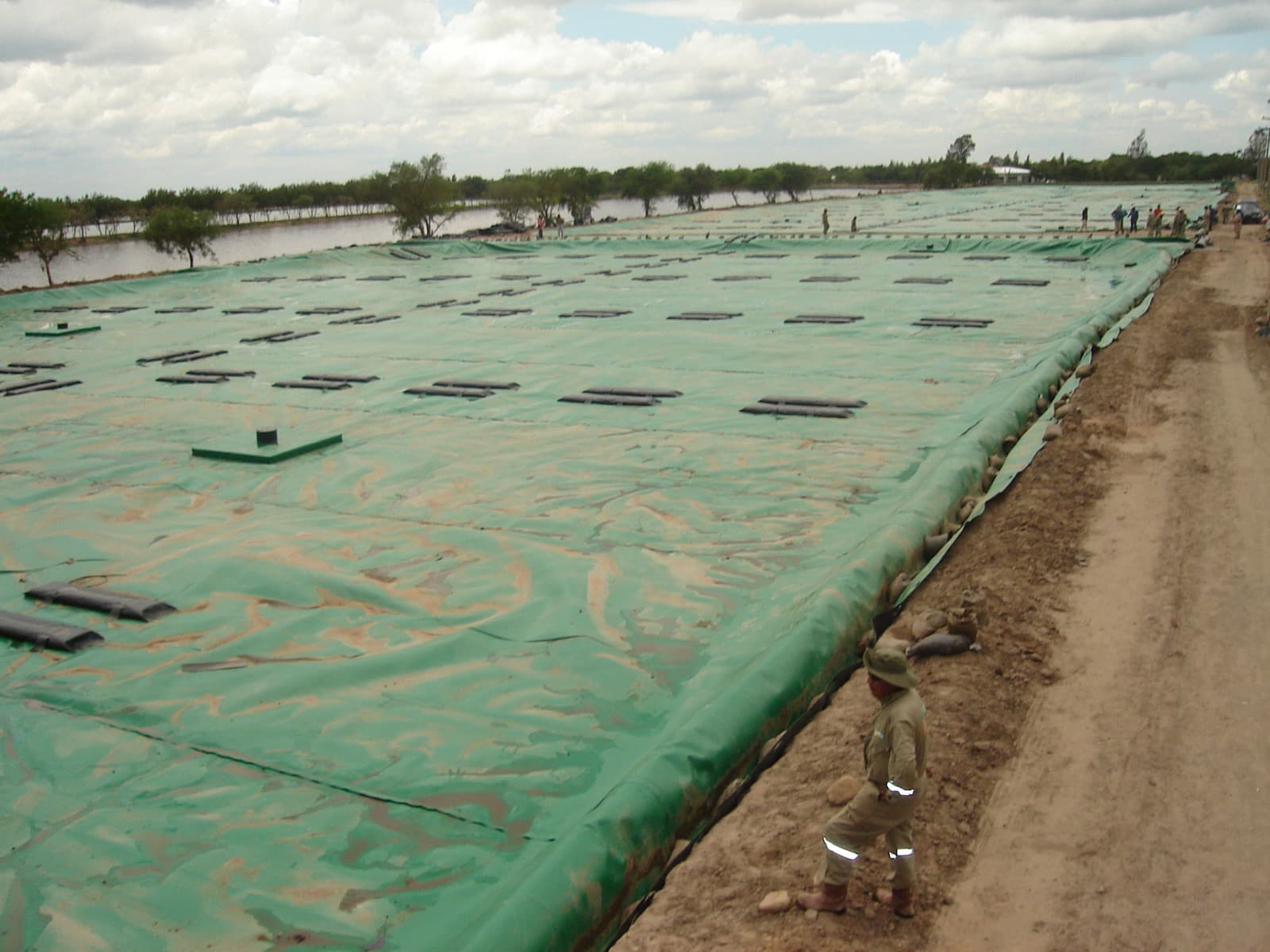
The Grand Coteau project represents a combined installation where both a floating cover and baffle curtains are being deployed on the same lagoon. This combination addresses both gas management (the cover captures biogas for destruction or utilization) and treatment optimization (the baffles improve HRT for better organic matter degradation). Combined installations are more efficient to construct because mobilization, site preparation, and material handling costs are shared between the two systems.
For operations that need both methane management and treatment improvement, the combined approach avoids two separate construction mobilizations and provides coordinated engineering design that ensures the cover and baffle systems work together rather than creating conflicts. Cover support systems and baffle anchoring can share structural elements, and the gas collection design can account for the flow patterns created by the baffle configuration.
Performance Data: Treatment Improvements with Baffles
Published performance data from baffled lagoon systems consistently shows significant treatment improvements. BOD (biochemical oxygen demand) removal efficiency typically increases by 15-30 percentage points after baffle installation -- from 70-75% removal in unbaffled lagoons to 85-95% removal in properly baffled systems. TSS (total suspended solids) removal shows similar improvements, particularly when the serpentine flow path includes a quiescent settling zone before the lagoon outlet.
- Effective HRT increase: 40-60% improvement over unbaffled lagoon of the same volume
- BOD removal: 15-30 percentage point improvement in most applications
- TSS removal: 10-25 percentage point improvement, particularly with outlet-adjacent settling zones
- Ammonia treatment: improved through extended contact time with nitrifying bacteria in aerated zones
- Pathogen reduction: longer retention time increases UV exposure and biological die-off in facultative lagoons
Cost Comparison: Baffles vs. Alternatives
The economics of baffle curtains are compelling when compared to the alternatives for improving lagoon treatment performance. A new lagoon of equivalent volume costs $500,000-$2 million and requires land acquisition, permitting, and 6-18 months of construction. A mechanical treatment system upgrade (activated sludge, SBR, or MBR) costs $1-10 million depending on capacity, requires ongoing energy and chemical costs, and demands skilled operator attention. A baffle curtain installation costs $50,000-$200,000, can be completed in 2-6 weeks, requires no land acquisition, and has minimal ongoing maintenance requirements.
The maintenance profile for baffle curtains is remarkably simple. Annual inspections of anchor points, flotation systems, and curtain membrane integrity are the primary maintenance activities. Occasional curtain repositioning or replacement of tensioning hardware may be needed over the 15-20 year expected life of a properly specified curtain system. There are no moving parts, no energy consumption, and no chemical requirements.
“Baffle curtains are the highest-ROI improvement you can make to an underperforming lagoon system. No moving parts, no energy cost, no chemicals, and you get 40-60% more treatment out of infrastructure you have already paid for.”
-- EFI USA