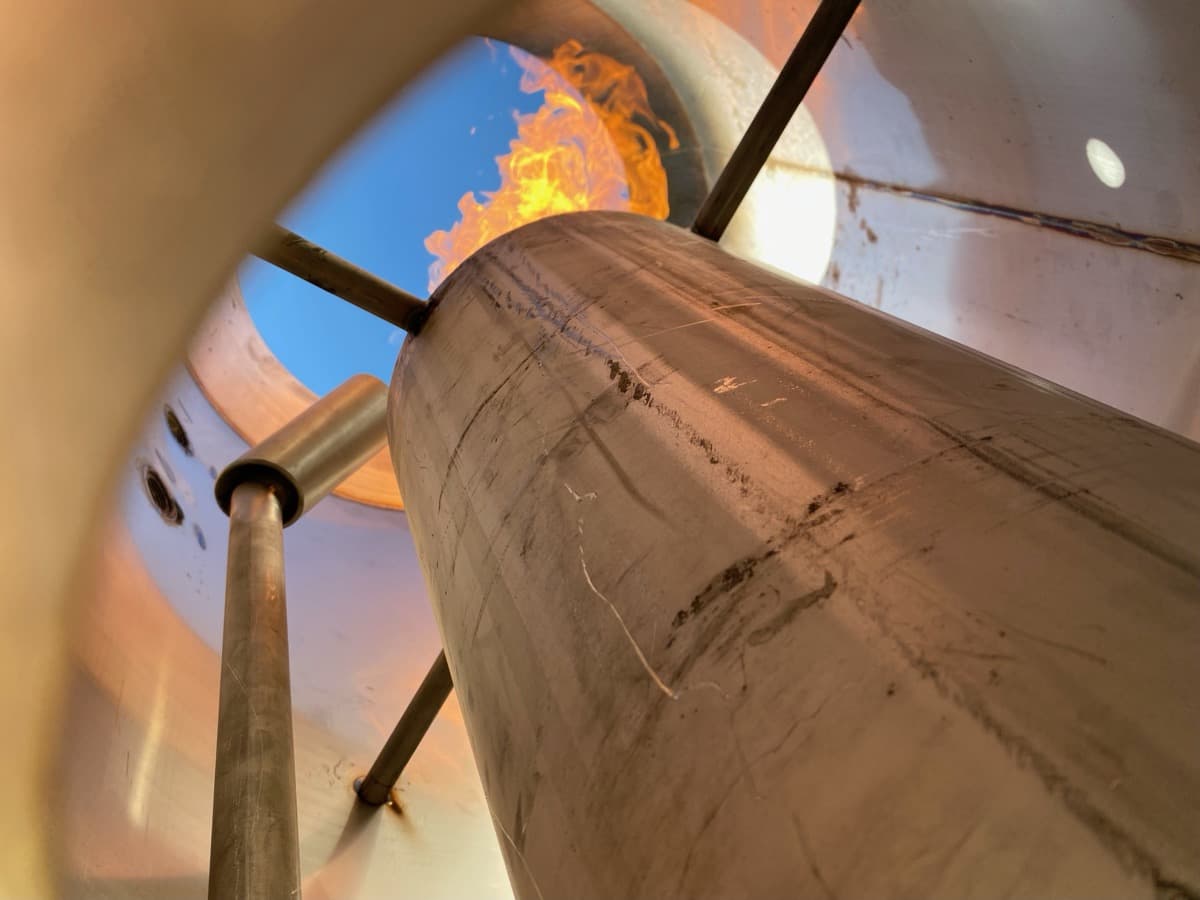
A flare burner assembly that should last ten years fails after two. Gas collection piping develops pinhole leaks along weld seams that passed inspection 18 months earlier. A pressure transmitter reads 30% low because the sensing diaphragm has thinned from the inside out. These are not manufacturing defects or installation errors. They are the predictable consequences of hydrogen sulfide exposure in biogas systems that lack adequate H2S treatment, and they follow a pattern that operators can learn to recognize before the failures become emergencies.
How H2S Attacks Metal
Hydrogen sulfide in biogas is corrosive through two primary mechanisms. The first is direct chemical attack. H2S reacts with iron and steel to form iron sulfide, a brittle, porous scale that flakes away and exposes fresh metal to continued corrosion. Unlike rust, which forms a partially protective oxide layer, iron sulfide provides almost no barrier. The corrosion proceeds inward at a roughly constant rate as long as H2S is present.
The second mechanism is more damaging and less visible. When biogas cools, even slightly, water condenses on pipe walls and equipment surfaces. H2S dissolves into that condensate to form a weak sulfuric acid solution. At concentrations typical of covered lagoon biogas, between 1,000 and 5,000 ppm H2S, the resulting condensate can reach pH levels below 3. That acidic film attacks carbon steel, copper alloys, and even some grades of stainless steel. Because the condensation happens preferentially at low points in piping, at flanged connections, and inside instrumentation housings, the damage concentrates at the components least likely to be inspected regularly.
Where Damage Shows Up First
EFI has maintained and operated biogas collection systems on covered lagoons across the United States for over 30 years. The corrosion pattern is remarkably consistent across different waste types, climates, and system configurations. Certain components fail first, and understanding that progression helps operators plan maintenance before failures force shutdowns.
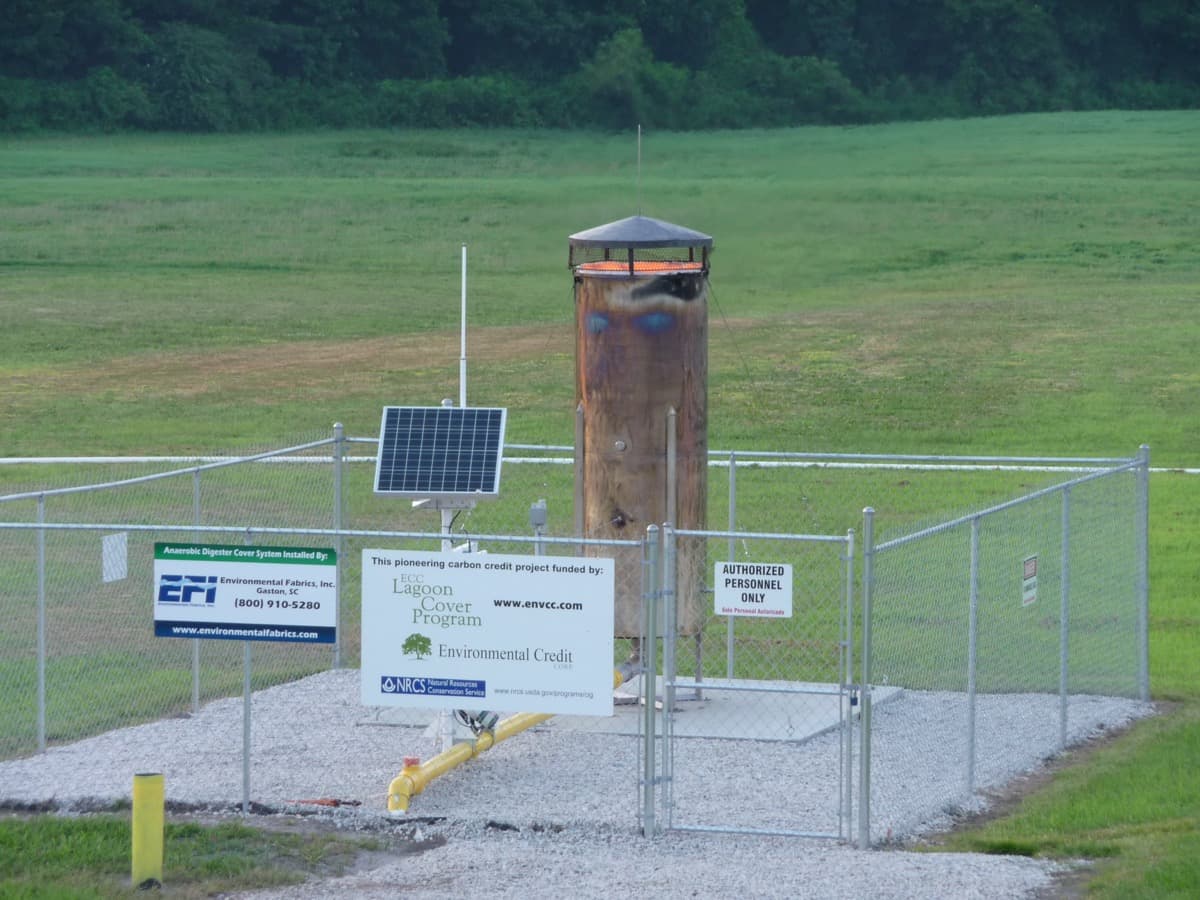
Flare burner assemblies are usually the first casualty. The burner tips, pilot igniters, and flame arrestor screens see the highest H2S concentrations at the highest temperatures. Thermal cycling accelerates the sulfide scale formation and shedding. Operators often notice degraded flame quality, harder ignitions, or increased pilot gas consumption months before the burner actually fails. Those are warning signs, not nuisances. A flare that cannot maintain reliable ignition is a compliance issue waiting to happen.
Gas collection piping fails next, typically at threaded fittings, weld seams, and low points where condensate pools. Threaded connections are particularly vulnerable because the threads reduce wall thickness and create crevices where condensate accumulates. Operators who switch from threaded to flanged connections with corrosion-resistant gaskets during routine maintenance significantly extend pipe life. The cost difference is modest compared to an unplanned shutdown to replace a failed pipe section.
The Instrumentation Problem
Corroded instrumentation is arguably the most dangerous consequence of untreated H2S because the failure mode is silent. A pressure transmitter that reads low due to diaphragm thinning does not trigger an alarm. It simply reports incorrect data. Flow meters with corroded sensing elements undercount gas volume. Temperature probes with degraded sheaths respond sluggishly. The system appears to be operating normally based on the instrument readings, but the readings are wrong.
EFI has documented cases where corroded instrumentation masked a 40% decline in biogas production for weeks because the flow meter had lost sensitivity. The operator did not realize production had dropped until a visual inspection of the flare revealed a smaller flame than expected. By that point, the underlying biological issue in the lagoon had progressed far enough to require intervention. Earlier detection, with accurate instruments, would have allowed a simpler correction.
Corrosion Rates and Planning Horizons
Published corrosion rate data for H2S exposure in biogas environments is limited, but EFI's field experience provides practical benchmarks. Carbon steel piping exposed to untreated biogas at 2,000 to 4,000 ppm H2S typically loses 0.5 to 1.5 mm of wall thickness per year, depending on condensation conditions. Standard Schedule 40 pipe with a nominal wall thickness of 6 mm can develop pinhole leaks in as little as 3 to 4 years. In humid climates where condensation is heavier, that timeline compresses.
Stainless steel (316L) resists the direct sulfide reaction but is still vulnerable to the acid condensate mechanism, particularly in crevices and under deposits. It buys time, typically 8 to 12 years in the same environment, but it does not eliminate the problem. The only reliable long-term solution is reducing H2S concentration in the gas before it reaches the infrastructure, which is why EFI designs H2S treatment into every new covered lagoon system.
Inspection Practices That Catch Problems Early
The most effective inspection approach for H2S corrosion is simple and does not require specialized equipment. Visual inspection of piping low points and fittings for orange or black sulfide deposits identifies the locations most at risk. Ultrasonic thickness testing at those locations, done annually, tracks wall loss over time and provides clear data for replacement planning. Most ultrasonic thickness gauges are portable, inexpensive, and require minimal training to operate.
For instrumentation, the best practice is periodic comparison against a reference measurement. Install a temporary calibrated pressure gauge alongside each permanent transmitter once per quarter. Compare the readings. Any deviation greater than 5% warrants pulling the instrument for inspection. The same approach works for flow meters: a temporary insertion probe can verify the permanent meter's accuracy in under an hour.
Flare inspections should include burner tip measurement. Many flare manufacturers specify minimum burner orifice diameters. As corrosion enlarges the orifices, flame velocity drops and the risk of flashback increases. Measuring orifice diameter annually takes minutes and provides a clear replacement threshold.
The Economics of Prevention vs. Replacement
Operators sometimes view H2S treatment as an optional upgrade, particularly on smaller systems where the capital cost of treatment equipment is a meaningful percentage of the total project budget. That calculation changes when the replacement costs are factored in. A flare burner assembly replacement runs $15,000 to $40,000 depending on system size, plus the downtime to install it. Replacing 200 feet of corroded gas collection piping costs $20,000 to $50,000 in materials and labor. Replacing corroded instrumentation across a typical covered lagoon system costs $5,000 to $15,000. These are not one-time costs. Without H2S treatment, they recur every 3 to 5 years.
An O2 injection system sized for the same installation typically costs $30,000 to $60,000 installed, with annual operating costs under $10,000. The economics favor treatment within the first replacement cycle on virtually every system EFI has evaluated. The math is straightforward, but operators who have not yet experienced their first major corrosion failure often underestimate the true cost until they are writing the check.
Building Corrosion Awareness into Operations
The operators who maintain the longest-running, lowest-cost biogas systems are not the ones with the most expensive equipment. They are the ones who treat H2S corrosion as a known, manageable variable rather than an unexpected failure. They monitor H2S levels continuously, inspect predictable failure points on a schedule, track wall thickness trends over time, and replace components proactively when the data indicates they are approaching end of life.
EFI builds this approach into every covered lagoon system we design and operate. H2S treatment, continuous monitoring, and a structured inspection schedule are not extras. They are fundamental to a system that performs reliably over its 20-year design life. For operators running existing systems without these measures, the first step is simple: measure your H2S levels and inspect your most vulnerable components. The data will tell you what to do next.
Review the gas treatment and corrosion problem together
Share operating data and the affected equipment so the review can identify the treatment duty and inspection scope.
- Gas flow range, H₂S measurements and equipment inlet limits
- Moisture and condensate handling, piping materials and inspection history
- Current treatment equipment, controls and recent operating changes