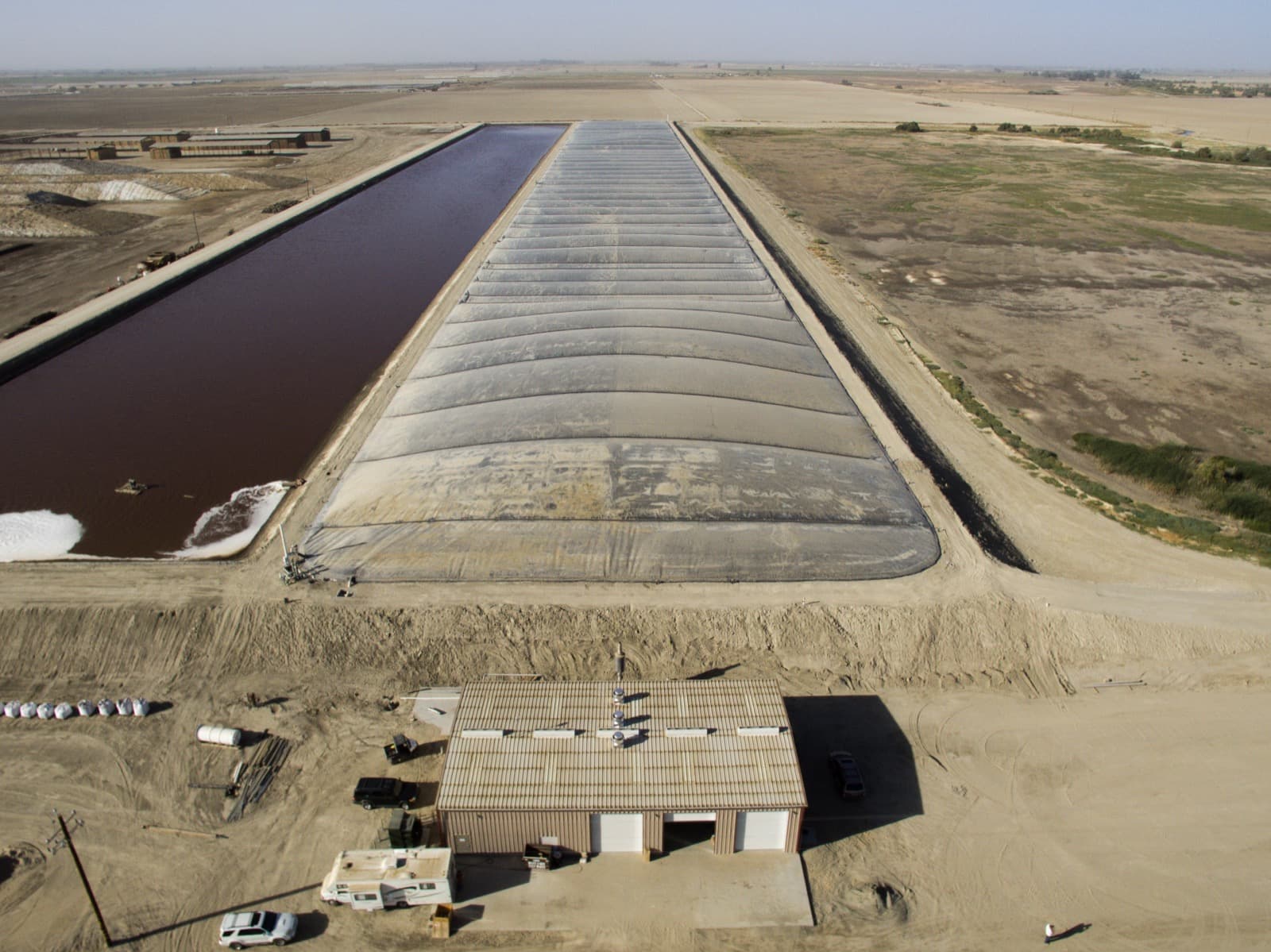
An open water reservoir in an arid or semi-arid climate can lose roughly four to seven feet of depth in a single year to evaporation. Spread across a multi-acre impoundment, that is millions of gallons that never reach a crop, a process line, or a tap. In the desert Southwest and much of California, pan evaporation often exceeds 80 inches a year, and every inch that leaves the surface is water that was captured, moved, or paid for once and now has to be replaced. For an operation that stores water because it is scarce or costly to move, that loss returns as a cost every dry season.
Where the Water Goes
Evaporation is driven by heat, wind, low humidity, and exposed surface area. A reservoir offers its entire surface to the sky, and the broader and shallower it is, the faster it returns water to the atmosphere. Operators have tried windbreaks, shade structures, and chemical surface films, but each either covers too little area or breaks down and washes away. The durable answer is a physical barrier that sits on the water and takes the surface out of contact with sun and wind.
That is what a floating cover does. A floating cover is a flexible geomembrane that rests directly on the water surface and rises and falls with the level. Anchored around the perimeter, it seals the impoundment against evaporation, sunlight, and airborne contamination while accommodating the level swings that come with drawdown and refill. Because it needs no interior structure spanning the water, whole-impoundment coverage stays practical at the scale of an irrigation reservoir or an industrial pond.
More Than Saved Water
Stopping evaporation is the headline benefit, but a cover over stored water does several jobs at once. By blocking sunlight, it suppresses the algae that turn open reservoirs green and pull operators into constant treatment. For raw or finished drinking water, that same shade limits the organic precursors behind disinfection byproducts, which keeps downstream treatment simpler and more predictable.
A sealed surface also keeps out what an open reservoir invites in. Windblown dust and debris, waterfowl and the contamination they carry, and general surface fouling all stay off the water. In storage that feeds irrigation or an industrial process, cleaner water means fewer clogged emitters, lighter filtration loads, and steadier water chemistry. Those water-quality gains often matter as much as the water the cover retains.
Where Covered Storage Pays Off
The case is clearest wherever stored water is scarce, treated, or hard to replace. Agricultural operations that hold irrigation water through a dry season lose a real share of it before it ever reaches a field, and a cover keeps that water banked in the reservoir. Municipal systems use covers on raw and finished water reservoirs to cut losses and protect quality between treatment and distribution. Industrial sites that recycle water in open process ponds hold both the volume and the temperature more steadily under a cover. Mining operations in arid regions use them on fresh-water and process ponds, where every acre-foot has been pumped or trucked a long way to get there.
Choosing a Cover Approach
Several cover types compete for evaporation duty, and the right one depends on the size and shape of the impoundment and how the water is used. Continuous floating geomembrane covers lay a single sealed membrane across the whole surface and anchor it at the perimeter. They deliver the highest evaporation reduction and the strongest contamination barrier because there are no open gaps. On larger reservoirs, a continuous cover usually adds a defined-sump layout, where a pattern of floats and ballast weights channels rainwater into sumps that are pumped off so it does not pool on the membrane.
Modular floating panels and cover balls are simpler to place and remove, and at close packing they cut evaporation substantially. What they give up is the contamination barrier. The gaps between elements leave part of the surface open to dust, debris, and waterfowl, so a continuous membrane is the stronger choice wherever water quality matters as much as retention. When a site needs frequent access to the water surface, a modular approach can be a reasonable trade.
Materials and Design Details
Material selection follows the water. UV-stabilized high-density polyethylene, typically 40 to 60 mil thick with 2 to 3 percent carbon black, is the workhorse for agricultural and industrial storage. Reinforced polypropylene adds dimensional stability and puncture resistance for larger or more exposed sites. For raw and potable drinking-water storage, the specification should call for materials carrying the appropriate potable-water certification, such as NSF/ANSI 61, so the cover never affects the water it protects.
An evaporation cover is also defined by what it leaves out. Because there is no biogas to collect, the surface skips the collection piping and condensate management a digester cover requires, though it still needs simple passive vents to release dissolved gas and keep the membrane from ballooning. That simplifies the layout, but the details that remain still decide whether the cover lasts. Perimeter anchoring has to tolerate the water-level swings of a working reservoir without pulling loose. Rainwater has to be shed or pumped off, since one inch of rain on a single acre of cover is roughly 27,000 gallons of added load. Wind uplift has to be managed on exposed sites. Handled correctly, a well-built cover holds up for 20 to 30 years.
A Long-Term Piece of Water Infrastructure
A floating cover is long-term water infrastructure, and it deserves the same engineering, fabrication, and installation discipline as the reservoir it protects. Panel welds, anchor trenches, drainage, and material specification all determine whether the system quietly saves water for decades or turns into a maintenance problem inside a few years.
EFI has spent more than 30 years building geosynthetic systems for water and waste impoundments, and covers are one of five core lines of work alongside liners, biogas systems, oxygen injection, and covered lagoons. That range matters on a water-storage project, because the cover, the liner beneath it, and the anchoring that ties them together are one system rather than three separate purchases. For an owner weighing a cover against the value of the water it would keep, the accounting is simple: measure how much stored water is leaving every summer, and what it costs to replace.