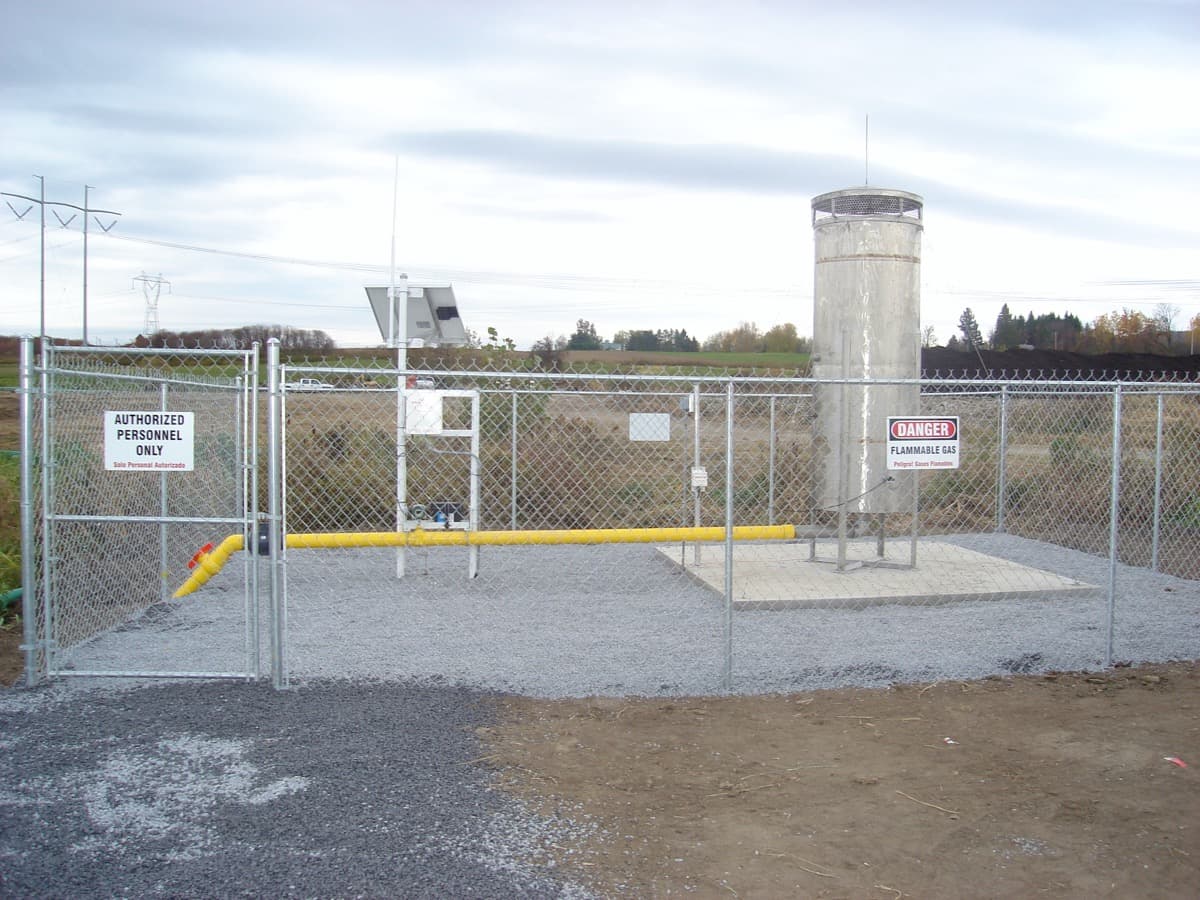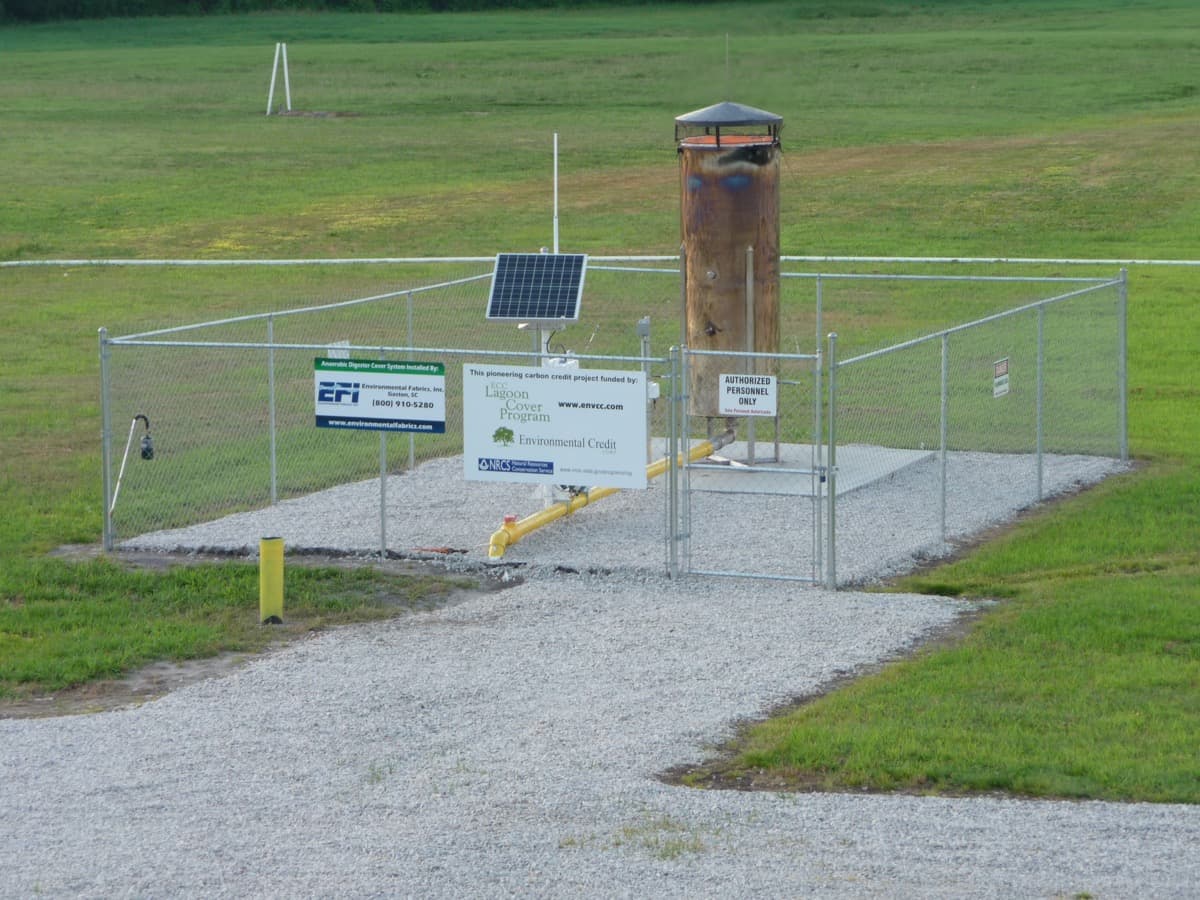
Raw biogas from a covered lagoon or anaerobic digester often carries hydrogen sulfide at 1,000 to 10,000 ppm, and no single treatment step brings that number down to what every end-use requires. A flare tolerates a few hundred ppm. A reciprocating engine wants far less. Pipeline-quality renewable natural gas measures its H2S limit in single-digit parts per million. The gap between raw gas and finished specification is usually too wide for one device to close economically, which is why serious biogas projects treat H2S in stages.
EFI USA has built covered lagoon and digester gas systems since 1993, and today accounts for a majority share of the covered lagoon systems operating in the United States. Across that fleet the pattern holds: the removal strategy that makes sense depends almost entirely on where the gas is going. Designing the treatment train backward from the end-use, rather than forward from the raw gas, is what keeps both capital and operating cost in line.
Why One Stage Rarely Fits
A media scrubber sized to take 5,000 ppm down to single digits in one pass burns through iron media or activated carbon at a rate that few projects can sustain. Biological removal inside the lagoon is inexpensive to operate but typically leaves 50 to 200 ppm of residual H2S. Neither extreme is the answer on its own.
A staged train solves this by dividing the work. Cheap capacity does the heavy lifting, and expensive capacity is reserved for the final polish. The result is a system where consumable spending tracks the specification the project actually needs, not the full sulfur load coming out of the lagoon.
Stage One: Bulk Removal Inside the Lagoon
The first and largest reduction happens before the gas ever leaves the cover. Small, controlled volumes of air injected into the headspace support sulfur-oxidizing bacteria that convert H2S to elemental sulfur and sulfate. Under stable operating conditions this biological step removes 95 to 99 percent of the incoming H2S, taking 3,000 to 5,000 ppm down to the low hundreds.
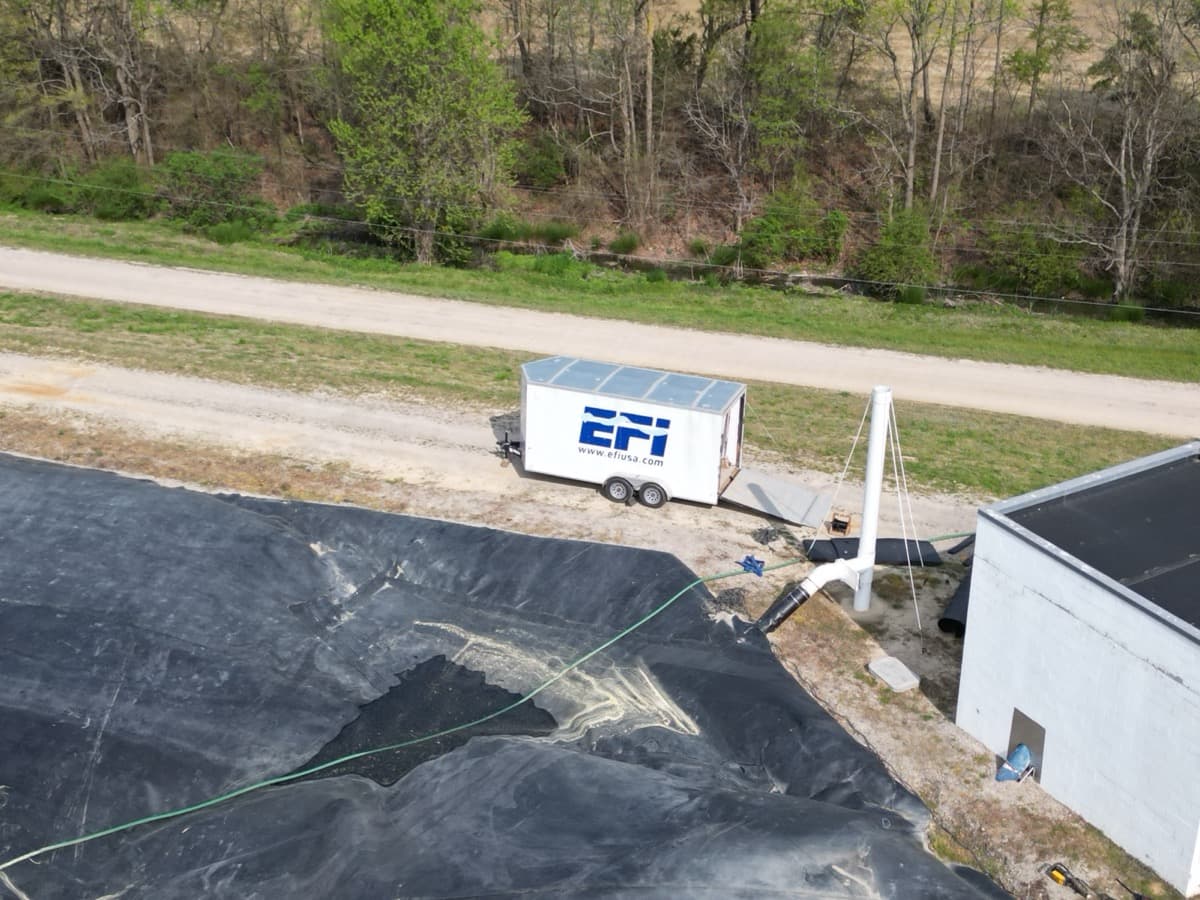
It runs on blower electricity rather than consumable media, which is what makes it the right tool for bulk load. EFI's oxygen injection skids are built for unattended operation in remote agricultural settings and hold the headspace oxygen concentration well below the lower explosive limit through continuous gas analysis. Because this stage carries the majority of the sulfur load, every stage downstream sees a smaller, steadier duty.
Stage Two: Polishing to Specification
With the bulk of the sulfur already gone, the polishing stage has a small and predictable load. A vessel of iron oxide media or impregnated activated carbon that would be overwhelmed by raw gas can run for months when its inlet is already down to a couple hundred ppm. This is where the train reaches the tighter targets: below roughly 100 ppm for many engine and boiler applications, and into the single digits where the gas is upgraded to pipeline specification.
Because the polishing vessel sees only a fraction of the total sulfur, media change-outs are infrequent and spent-media disposal volumes stay manageable. Sizing this stage is a matter of matching media type and vessel volume to the inlet concentration the biological stage reliably delivers, plus a margin for the days that stage runs slightly off its target.
Monitoring and Control Tie the Stages Together
A staged train only performs if each stage is measured. Gas analysis at the lagoon outlet confirms the biological stage is holding its removal rate, and a second measurement after the polishing vessel signals when media is approaching breakthrough. Oxygen concentration in the gas stream is monitored as a safety parameter, with interlocks that prevent over-injection.
Without this instrumentation, operators tend to fail in one of two directions. They change media too early and waste it, or too late and send off-spec gas into an engine or an upgrading skid that cannot tolerate it. The monitoring is what turns two independent devices into a train that can be trusted to hold a specification.
Designing the Train Backward from the End-Use
The right configuration follows from a short set of questions. What is the H2S tolerance of the end-use equipment. How remote is the site, and how reliable is media delivery. Is this a new build or a retrofit onto an existing cover. A remote flare project may need only the biological stage and a modest polishing vessel. An engine or pipeline project justifies a larger, well-instrumented polishing train because the downstream equipment is far less forgiving and far more expensive to repair.
Retrofits are common. Many covered lagoons were built for flaring and later needed to feed an engine or an upgrading skid as the gas offtake changed. Adding a biological bulk-removal stage and a right-sized polishing vessel is usually less disruptive, and less costly to operate, than replacing a scrubber that was oversized for the original duty.
What This Means for Owners
The cost of H2S treatment is dominated by the operating years, not the day of installation. A train that leans on inexpensive biological removal for bulk load and reserves media for the final polish keeps consumable spending proportional to the specification actually required, rather than paying premium rates to strip sulfur that a cheaper stage could have handled. For a system expected to run a decade or more, that difference compounds quietly across every media change-out avoided.
“We design the treatment train around where the gas is going, not just what comes out of the lagoon. Matching each stage to its real load is what keeps the operating cost defensible over a project's life.”
-- EFI USA
EFI USA designs, builds, and commissions H2S treatment for covered lagoon and digester gas systems across a range of end-uses, from flaring to engine generation to pipeline upgrading. Contact our team to review the removal strategy for a new or existing biogas project.