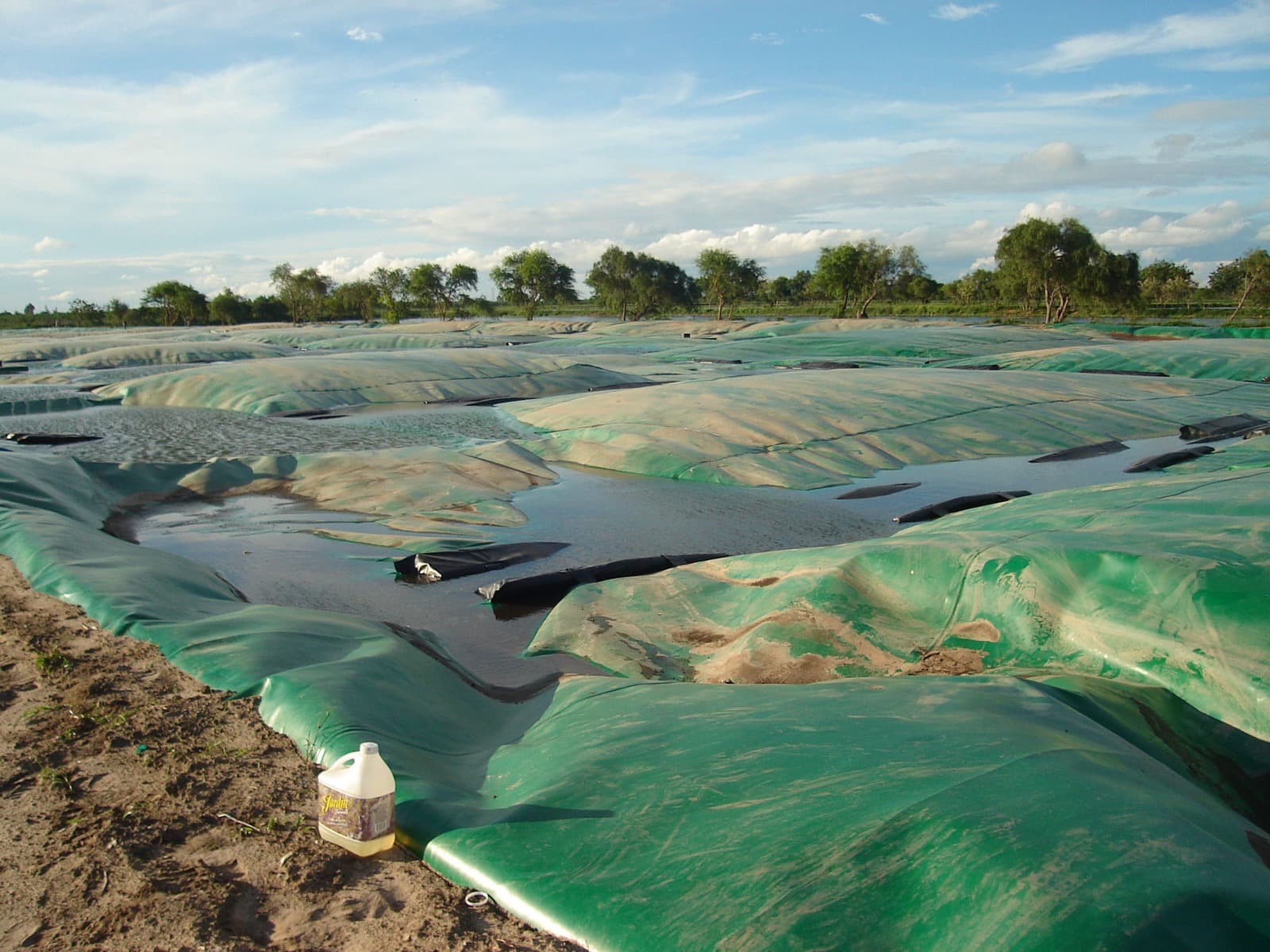
When specifying a floating cover for a lagoon, pond, or reservoir, the first design decision is whether the application requires an impermeable (gas-tight) cover or a permeable cover that allows gas exchange while controlling other factors. The choice depends on whether biogas capture is a project objective, the specific environmental concerns being addressed, and the long-term operational requirements.
EFI USA manufactures and installs both impermeable geomembrane covers and our 3R permeable foam cover system. Having both technologies in our portfolio allows us to recommend the right solution for each application without being locked into a single product.
Impermeable Floating Covers
Impermeable floating covers are continuous geomembrane sheets (typically 40-60 mil HDPE or LLDPE) that float on the lagoon surface and form a gas-tight seal. All biogas generated beneath the cover is captured and routed through a gas collection system. These covers are the standard for biogas capture, methane destruction, and any application where gas containment is required.
- Applications: Biogas capture and methane destruction, RNG production, odor containment for high-strength wastewater, regulatory compliance for emission limits.
- Materials: 40-60 mil HDPE (most common), LLDPE for applications requiring greater flexibility, reinforced polypropylene (RPP) for special applications.
- Gas management: Requires a complete gas collection system including piping, blowers, condensate management, and a flare or utilization device.
- Rainwater management: Requires pumps or drainage systems to remove rainwater from the cover surface, as water cannot pass through the membrane.
- Lifespan: 20-30+ years for quality HDPE covers with proper maintenance.
Permeable Floating Covers: EFI's 3R Foam Technology
EFI's 3R permeable floating cover uses modular closed-cell foam panels that float on the lagoon surface. Unlike impermeable covers, the 3R system allows gas exchange through the gaps between panels while providing effective coverage for specific treatment objectives.
The 3R system was developed to address applications where full gas containment is not needed or not cost-justified, but surface coverage provides significant operational benefits. The foam panels are UV-stabilized, chemically resistant, and designed for 15-20+ years of service in harsh lagoon environments.
- Algae prevention: By blocking 90-95% of sunlight from reaching the water surface, 3R covers dramatically reduce algae growth in storage ponds and polishing lagoons.
- Evaporation reduction: 3R covers reduce water evaporation by 70-85%, making them valuable for water conservation in arid regions and for industrial process water storage.
- Temperature moderation: The insulating foam layer reduces heat loss from the lagoon surface, maintaining more consistent treatment temperatures in winter months.
- Odor reduction: While not gas-tight, 3R covers reduce odor emissions by 60-80% by limiting surface turbulence and reducing the exposed water surface area.
- Easy installation: Modular foam panels are placed on the water surface without welding, anchoring, or heavy equipment. Installation time is typically 50-70% less than impermeable covers.
Cost Comparison
Permeable 3R covers typically cost 30-50% less than impermeable geomembrane systems on an installed basis. The savings come from simpler installation (no welding, no anchor trenches), no gas collection system requirement, no rainwater management pumps, and lower maintenance costs over the system life.
However, if the application requires biogas capture for carbon credits, energy recovery, or regulatory emission compliance, an impermeable cover is the only option. The 3R system is not a substitute for gas-tight containment -- it is a different tool for different applications.
Choosing the Right Cover Type
- Choose impermeable if: You need biogas capture, methane destruction for carbon credits, complete odor containment, or regulatory compliance for gas emissions.
- Choose permeable (3R) if: Your primary goals are algae control, evaporation reduction, partial odor reduction, or temperature management without the need for gas capture.
- Consider a hybrid approach: Some facilities use impermeable covers on primary anaerobic lagoons (for biogas capture) and 3R permeable covers on secondary polishing lagoons (for algae and evaporation control).
“Not every lagoon needs a gas-tight cover, and not every application justifies the cost. The 3R system gives us a tool for the applications where coverage matters but gas capture does not.”
-- EFI USA Technical Team
Contact EFI to discuss which cover technology is right for your application. Our engineers will evaluate your site, treatment objectives, and budget to recommend the most cost-effective solution.