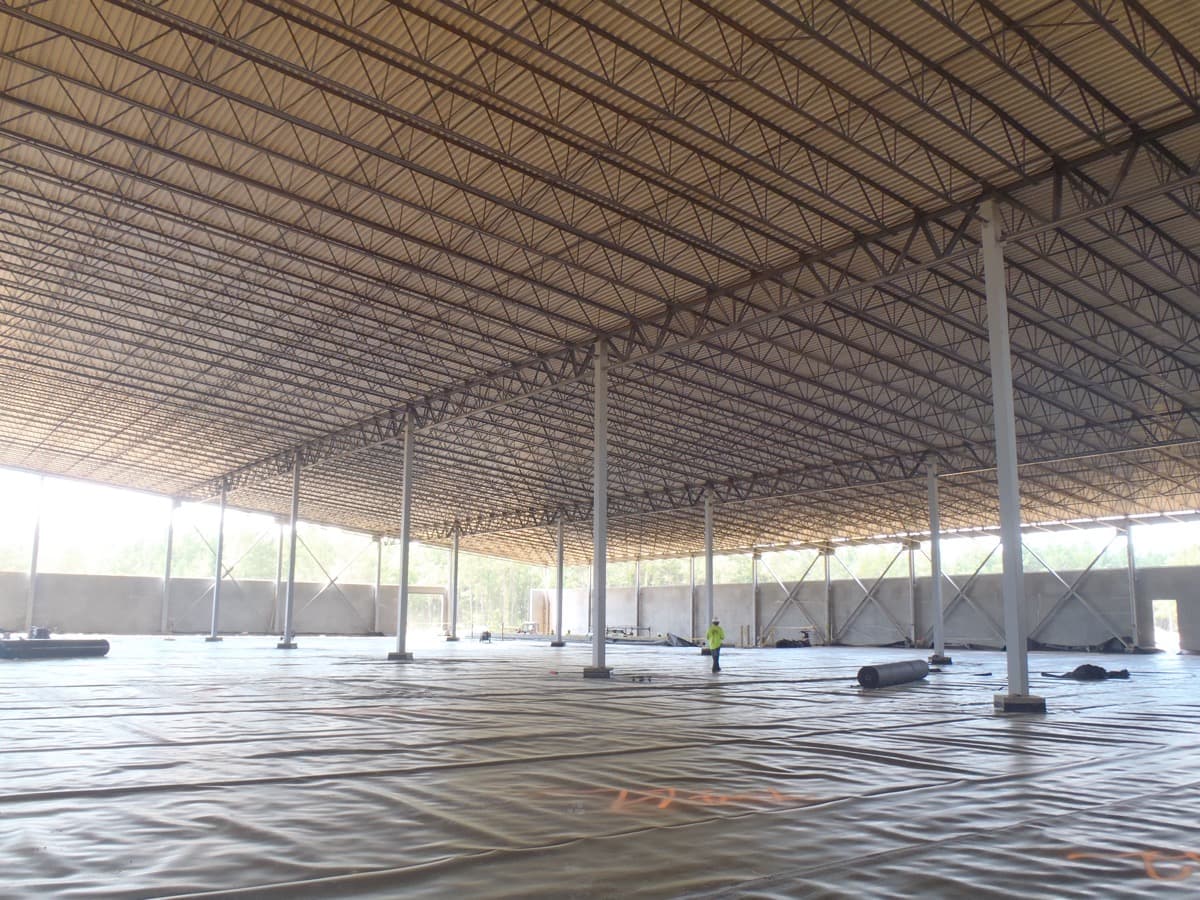
A single-liner containment system relies on one barrier between the contained material and the environment. If that barrier fails -- through a manufacturing defect, installation error, mechanical damage, or material degradation -- there is no backup. The contained material enters the subsurface, and the operator may not know it has happened until groundwater contamination is detected months or years later.
Double-lined containment systems address this risk by adding a secondary liner below the primary liner, with a leak detection and collection layer between them. If the primary liner develops a leak, the leaked material is captured in the detection layer, collected in a sump, and measured. The operator knows immediately that a leak has occurred, can quantify its magnitude, and can plan repairs. Meanwhile, the secondary liner continues to protect the environment.
System Components
- Primary liner: The upper geomembrane that directly contacts the contained material. Typically 60-80 mil HDPE for most applications. This is the working liner that handles the chemical and mechanical loads.
- Leak detection layer: A high-transmissivity drainage layer between the primary and secondary liners. This can be a granular drainage blanket (sand or gravel), a geocomposite drain (geonet with geotextile), or a combination. The layer must transmit leaked fluid to the collection sump quickly enough to prevent significant head buildup on the secondary liner.
- Leak detection sump: A low point in the detection layer where leaked fluid collects. Equipped with a pump or gravity drain to remove fluid and allow flow measurement. Flow rates above background indicate a primary liner leak.
- Secondary liner: The lower geomembrane that provides backup containment. Typically the same material and thickness as the primary liner, though some designs use a thinner secondary liner when risk assessment supports it.
- Subgrade: The prepared soil foundation beneath the secondary liner. Must meet the same compaction and smoothness standards as a single-liner subgrade.
When Double Liners Are Required
Several categories of containment facilities are required by regulation to have double-lined systems. The common thread is that these facilities contain materials where a release would cause significant, potentially irreversible environmental damage.
- Hazardous waste landfills: RCRA Subtitle C requires double liners with leak detection for all new hazardous waste landfill units.
- Municipal solid waste landfills: RCRA Subtitle D requires composite liners (geomembrane over compacted clay) for municipal landfills. Some states require full double-liner systems for landfills over vulnerable aquifers.
- Mining heap leach pads: Most western states require double-lined systems for new heap leach facilities that use cyanide or acid leach solutions.
- Surface impoundments: RCRA requires double liners for surface impoundments receiving hazardous waste. Some states extend this to impoundments receiving industrial wastewater.
- Petroleum storage: Some states require double-lined systems for above-ground petroleum storage facilities and loading areas.
When Double Liners Are Not Required but Recommended
Even when regulations allow single-liner systems, there are situations where the risk-reward calculus favors double liners. The incremental cost of the second liner and detection layer is typically 40-60% of the primary liner cost, which is modest compared to the cost of groundwater remediation.
- Facilities over sensitive aquifers: If the facility overlies a sole-source aquifer or a drinking water supply aquifer, the consequences of a leak are so severe that double containment is prudent regardless of regulatory requirements.
- High-value contents: If the contained material has significant monetary value (e.g., process solutions in mining), leak detection allows recovery of leaked material in addition to environmental protection.
- Long service life requirements: For facilities that must maintain containment for 50+ years (such as closure caps or permanent impoundments), double liners provide insurance against the uncertainty of very long-term material performance.
- Litigious environments: In areas with active environmental litigation, the ability to demonstrate proactive over-compliance with containment standards can reduce legal exposure.
Leak Detection System Design
The effectiveness of a double-liner system depends entirely on the performance of the leak detection layer. A detection layer that cannot efficiently transmit leaked fluid to the collection sump will allow head to build up on the secondary liner, increasing the probability of a dual-liner breach and delaying leak detection.
Design standards typically require that the leak detection layer maintain less than 1 foot of head on the secondary liner under maximum anticipated leak conditions. This requires sufficient hydraulic transmissivity in the drainage layer, adequate slope toward the collection sump, and a sump with sufficient capacity and pump-out capability. EPA guidance recommends a minimum drainage layer transmissivity of 3 x 10^-2 m2/sec.
Cost-Benefit Analysis
The cost premium for a double-liner system over a single-liner system varies by project size and site conditions but typically falls in the range of $2-$5 per square foot of lined area. For a 5-acre facility, this represents an incremental cost of $435,000 to $1.1 million. Against this cost, consider that groundwater remediation for a single containment breach can cost $1-$10 million or more, regulatory penalties for a documented release can be substantial, and business interruption during investigation and remediation adds further cost.
EFI USA designs and installs double-lined containment systems for applications ranging from small industrial ponds to large mining facilities. Our experience with both single and double systems allows us to advise clients on the most appropriate and cost-effective approach for their specific situation. Contact us for a project-specific evaluation.