Landfill liner systems are among the most engineered containment structures in environmental construction. Federal and state regulations mandate specific liner configurations designed to prevent leachate from contaminating groundwater and soil. A modern landfill liner system is not a single layer of plastic -- it is a multi-component engineered system with redundant barriers, leak detection, and quality assurance requirements.
EFI USA has installed landfill liner systems for municipal solid waste, hazardous waste, and industrial waste facilities. Our rigorous CQA protocols ensure that every installation meets or exceeds regulatory requirements and design specifications.
Regulatory Framework: RCRA and State Requirements
The Resource Conservation and Recovery Act (RCRA) establishes minimum federal standards for landfill liner systems. Subtitle D covers municipal solid waste landfills and requires a composite liner (geomembrane over compacted clay or GCL) with a leachate collection system. Subtitle C covers hazardous waste and requires a double liner system with leak detection between the primary and secondary liners.
Many states have adopted regulations that exceed RCRA minimums. California, for example, requires double composite liners for Class II and Class III landfills. Understanding the applicable regulatory framework is the first step in liner system design.
Components of a Double-Lined System
A fully engineered double-lined landfill system, from bottom to top, includes these layers:
- Prepared subgrade: Compacted native soil graded to design contours. The foundation for the entire system.
- Secondary (lower) geomembrane: Typically 60 mil smooth HDPE. This is the last line of defense against groundwater contamination.
- Secondary GCL (geosynthetic clay liner): A manufactured layer of bentonite clay sandwiched between geotextiles. When hydrated, the bentonite swells to create an extremely low-permeability barrier (hydraulic conductivity of 1x10^-9 cm/sec or less).
- Leak detection layer: A granular drainage layer or geonet between the primary and secondary liners. Any leachate that passes through the primary liner is collected here, allowing operators to detect and quantify leakage. This is the sentinel layer of the system.
- Primary (upper) geomembrane: Typically 60-80 mil textured HDPE. Textured surfaces provide friction for waste stability on side slopes.
- Primary GCL: Another bentonite clay layer providing redundant low-permeability protection above the primary geomembrane.
- Leachate collection system: A drainage layer (gravel or geocomposite) with perforated collection pipes that remove leachate from the base of the waste mass and route it to a leachate management system.
- Protective geotextile: A heavy-weight non-woven geotextile that protects the primary liner from puncture by drainage stone and overlying waste.
HDPE Geomembrane Selection
HDPE is the dominant geomembrane material for landfill applications due to its chemical resistance, mechanical strength, and long-term durability. Key specifications include:
- Thickness: 60 mil minimum for most landfill applications; 80 mil for primary liners in hazardous waste facilities or high-load applications.
- Resin type: Virgin HDPE with a density of 0.940-0.947 g/cm3 and a melt index of 0.06-0.20 g/10 min.
- Surface texture: Smooth on the bottom (for GCL contact) and textured on the top (for friction with overlying materials). Double-textured on side slopes.
- UV stabilization: Carbon black content of 2-3% for UV resistance during installation and at exposed areas.
- Stress crack resistance: SP-NCTL testing per ASTM D5397 with minimum 400 hours to failure.
GCL: The Clay Barrier Layer
Geosynthetic clay liners (GCLs) have largely replaced traditional compacted clay liners in landfill construction. GCLs offer equivalent or superior hydraulic performance in a manufactured product that is faster to install, requires no on-site clay processing, and maintains consistent quality. A typical GCL contains 0.75-1.0 lbs/sq ft of sodium bentonite between woven and non-woven geotextile layers, needle-punched together for internal shear strength.
Leak Detection and Monitoring
The leak detection layer between primary and secondary liners is both a regulatory requirement and an operational necessity. It provides continuous data on primary liner performance. Regulatory action levels for leak detection flow rates vary by jurisdiction but typically trigger investigation at 20-50 gallons per acre per day and require response at higher rates.
Modern leak detection systems include automated flow monitoring, sample collection ports for leachate characterization, and remote monitoring capabilities. EFI's installations include provisions for all monitoring requirements specified in the facility permit.
Installation Quality Assurance
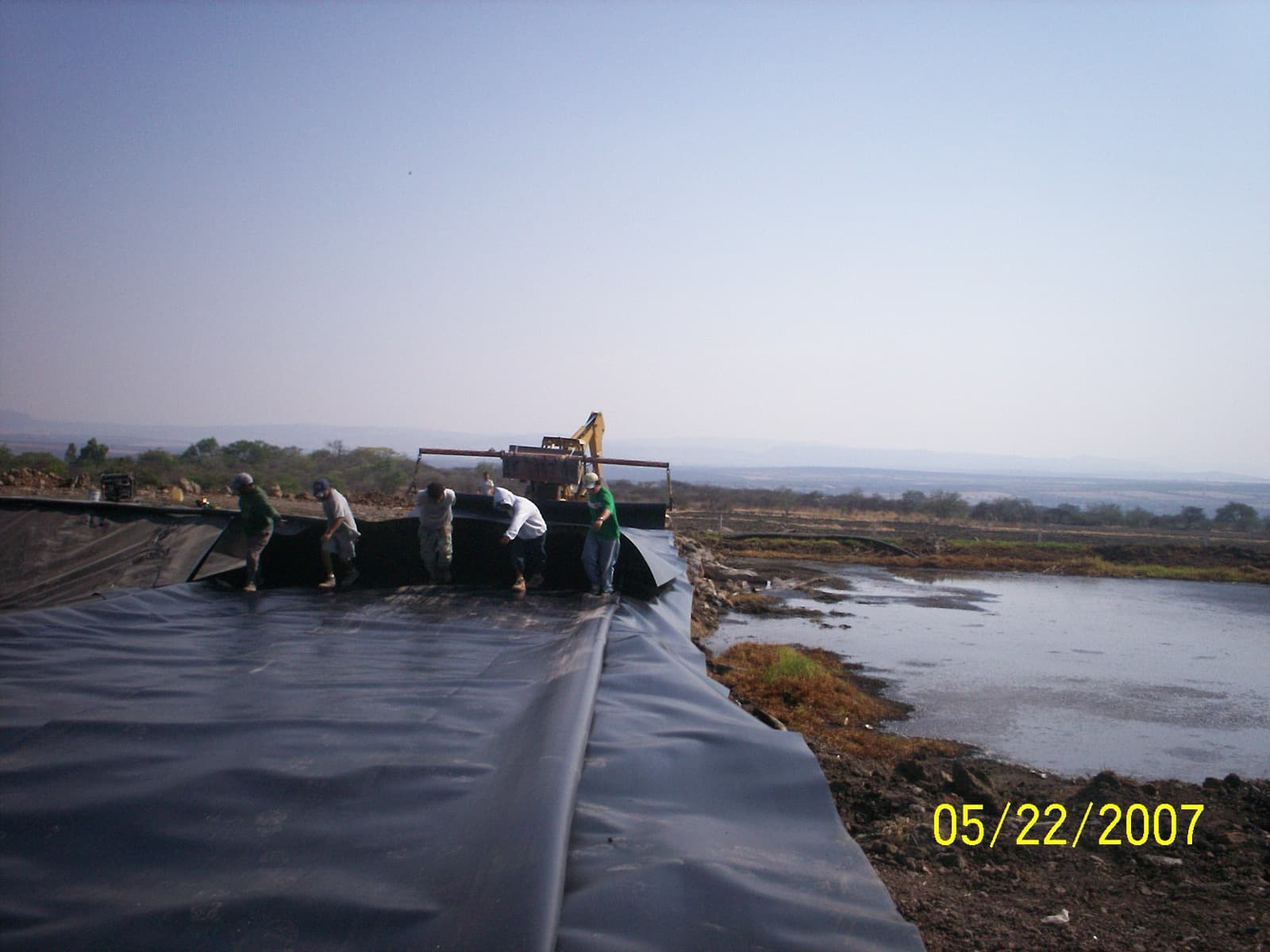
Landfill liner installation requires the highest level of CQA in geosynthetic construction. Every seam is tested, every panel is documented, and a third-party CQA inspector monitors every phase of installation. EFI's QA protocols include destructive seam testing every 150 linear feet, air pressure testing of all dual-track wedge welds, vacuum box testing of all extrusion welds and detail work, electrical leak location surveys of the completed liner, and full documentation and as-built drawings for regulatory submittal.
“A landfill liner is designed to function for decades under the most demanding conditions in geosynthetic engineering. There is no opportunity for post-installation repair once waste is placed. The installation must be right the first time.”
-- EFI USA Technical Team
Contact EFI for landfill liner system design support, installation services, and CQA inspection. Our teams have the expertise to handle the most demanding containment projects.