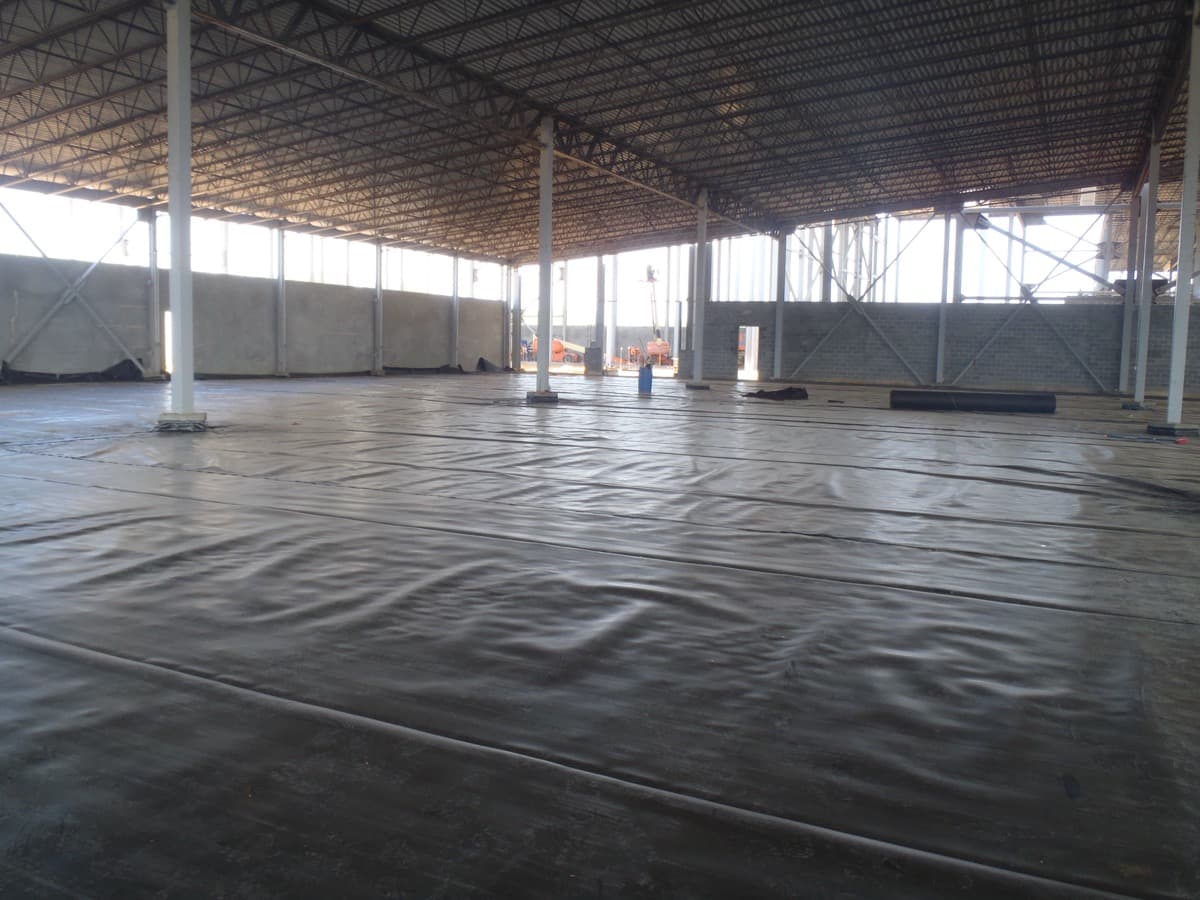
Liner installation projects do not always have the luxury of waiting for ideal weather. Agricultural operations on regulatory deadlines, mining projects with fixed schedules, and municipal upgrades that must be completed before spring runoff all create demand for cold-weather installation. EFI USA has completed hundreds of liner installations in temperatures ranging from the low 20s to well below freezing, and the key takeaway is this: winter installation is entirely viable, but it requires specific adjustments to technique, scheduling, and quality control.
The primary challenges of cold-weather installation are material stiffness, thermal contraction, slower welding speeds, and condensation on liner surfaces. Each of these can be managed with proper planning and experienced crews. Ignoring them leads to brittle seams, stress cracking, and premature liner failure.
Understanding HDPE Behavior in Cold Temperatures
HDPE is a semicrystalline thermoplastic, and its mechanical properties are temperature-dependent. At temperatures below 40 degrees Fahrenheit, HDPE becomes noticeably stiffer and more brittle. The coefficient of thermal expansion for HDPE is approximately 1.2 x 10^-4 per degree Celsius, meaning a 100-foot panel will contract roughly 1.5 inches for every 20-degree Fahrenheit drop in temperature. This contraction creates tensile stress at seams and anchor points.
The practical consequence is that panels deployed and welded in cold conditions will attempt to shrink further if temperatures drop overnight. Conversely, if panels are deployed tight in cold weather and temperatures subsequently rise, the expansion can create large wrinkles. Managing this thermal cycling is one of the most important aspects of winter installation.
Pre-Installation Planning for Cold Weather
- Schedule welding during the warmest part of the day. In winter, this typically means starting seam welding at 10:00 AM and finishing by 3:00 PM. Early morning and late afternoon should be reserved for panel deployment, anchoring, and preparation work.
- Monitor weather forecasts closely. Avoid welding if rain, snow, or heavy frost is expected within 4-6 hours. Moisture on the liner surface is the single biggest cause of seam defects in winter.
- Pre-stage material in heated enclosures when possible. HDPE rolls stored at 50-60 degrees Fahrenheit deploy more easily and weld more reliably than material that has been sitting at ambient winter temperatures.
- Plan for reduced daily productivity. Winter installations typically achieve 60-75% of the daily panel coverage of summer installations due to shorter welding windows and additional QA requirements.
- Ensure adequate lighting for late-afternoon QA testing. Shorter daylight hours mean visual inspections and testing may extend past sunset.
Welding Adjustments for Cold Conditions
Both hot wedge and extrusion welding require significant parameter adjustments in cold weather. The fundamental issue is that cold liner surfaces absorb heat faster, requiring either higher temperatures, slower travel speeds, or both to achieve proper fusion.
- Increase hot wedge temperature by 20-40 degrees Fahrenheit above summer settings. The exact adjustment depends on ambient temperature, wind speed, and liner thickness.
- Reduce travel speed by 20-30%. Slower travel allows more heat transfer into the cold liner material, ensuring adequate melt depth on both surfaces.
- Use windscreens. Wind chill accelerates heat loss from the weld zone. Portable windscreens positioned around the welding machine can increase effective weld zone temperature by 10-15 degrees.
- Preheat liner surfaces at the weld zone using a propane torch or heat gun on the overlap area ahead of the welding machine. This is standard practice below 32 degrees Fahrenheit.
- Increase trial weld frequency. In cold conditions, EFI performs trial welds every 2 hours instead of the standard 4-hour interval, and whenever the ambient temperature changes by more than 10 degrees.
Managing Thermal Contraction and Stress
Thermal contraction is the most underestimated risk in winter liner installation. If panels are welded tight at 30 degrees Fahrenheit and the temperature drops to 10 degrees overnight, the resulting contraction can stress seams to their yield point. Over multiple thermal cycles, this leads to stress cracking -- the number one failure mode for HDPE liners.
- Deploy panels with intentional slack. In winter, panels should have slightly more slack than summer installations to accommodate contraction without overstressing seams.
- Avoid anchoring panels tightly until the full liner system is welded. Premature anchoring locks in stress that thermal cycling will concentrate at seam intersections.
- Complete welding and anchoring across the full liner area within the same temperature window when possible. Welding half the panels at 40 degrees and the other half at 20 degrees creates differential stress at the junction.
- Cover welded seams with insulating blankets overnight if temperatures are expected to drop significantly. This slows the cooling rate and reduces peak contraction stress.
Moisture and Condensation Control
Moisture is the enemy of HDPE welding in any season, but it is particularly problematic in winter. Condensation forms on liner surfaces as temperatures fluctuate around the dew point, and frost can be invisible on dark HDPE material in early morning conditions. Any moisture trapped in a seam creates a void that weakens the weld and can propagate into a leak under hydrostatic load.
EFI crews use the following moisture control protocols in winter: all liner surfaces within 6 inches of a seam are wiped dry immediately before welding. Towels and rags are replaced frequently as they absorb moisture and become ineffective. If frost is present, the seam area is heated with a propane torch until all moisture has evaporated. No welding proceeds until the seam area passes a visual and touch inspection for dryness.
Quality Assurance in Cold Weather
Cold-weather QA protocols must account for the fact that destructive test specimens may behave differently at low temperatures. HDPE tested at 20 degrees Fahrenheit will exhibit higher shear strength but lower elongation than the same material tested at 70 degrees. Testing standards (ASTM D6392) specify test temperature, so field specimens must be conditioned to the standard temperature before testing.
Air pressure testing of dual-track seams can be affected by temperature. Air contracts as it cools, which can mimic a pressure drop and produce false failure readings. EFI compensates by allowing pressurized seams to equilibrate to ambient temperature before beginning the monitoring period. Vacuum box testing is generally unaffected by cold weather, though soapy solutions may require antifreeze additives below 25 degrees Fahrenheit.
When to Postpone Installation
While EFI has successfully installed liners in extreme cold, there are conditions where postponement is the right call. Sustained winds above 25 mph combined with temperatures below 20 degrees make safe and quality installation impractical. Active precipitation -- rain, sleet, or snow -- on liner surfaces precludes welding. And if the subgrade is frozen solid, it may not be possible to achieve proper compaction for anchor trenches. In these cases, the most cost-effective approach is to complete subgrade work, stage materials, and wait for a weather window.
EFI USA has been installing liners in cold climates since 1993. Our crews are experienced in managing every aspect of winter installation, from material handling to thermal stress management. If your project timeline requires winter work, contact us to discuss site-specific planning and scheduling.