When dairy operators evaluate methane capture, the first question is always about money. Not environmental impact, not regulatory compliance, not neighbor relations -- money. Will this pay for itself? How long will it take? What is the downside? After 500+ installations over 32 years, EFI has enough operational data to answer these questions with precision, not projections. The numbers that follow are drawn from actual project performance across operations ranging from 200-cow family dairies to 10,000+ head confined operations.
The Revenue Engine: Carbon Credits from Methane Destruction
The primary revenue stream for dairy methane capture projects is verified carbon credits. When methane is captured under a covered lagoon digester and destroyed in an enclosed flare, each tonne of methane eliminated generates carbon offset credits under protocols like the American Carbon Registry (ACR) or Verra's Verified Carbon Standard (VCS). Methane has a global warming potential of 28x CO2 over a 100-year horizon (or 84x over 20 years), which means destroying one tonne of methane is equivalent to eliminating 28 tonnes of CO2 -- a significant credit volume per unit of gas destroyed.
A dairy operation with 1,000 milking cows typically produces 150,000 to 300,000 cubic feet of biogas per day from its waste lagoon, depending on climate, feed ration, and waste management practices. Warmer climates (Southeast, Southwest) produce more biogas due to higher biological activity in the lagoon. This biogas volume translates to roughly 400-1,200 tonnes of methane annually. At current voluntary carbon market prices of $15-$40 per tonne of CO2 equivalent, the annual carbon credit revenue ranges from $170,000 to over $1 million for a single dairy operation.
Capital Costs: What You Actually Pay
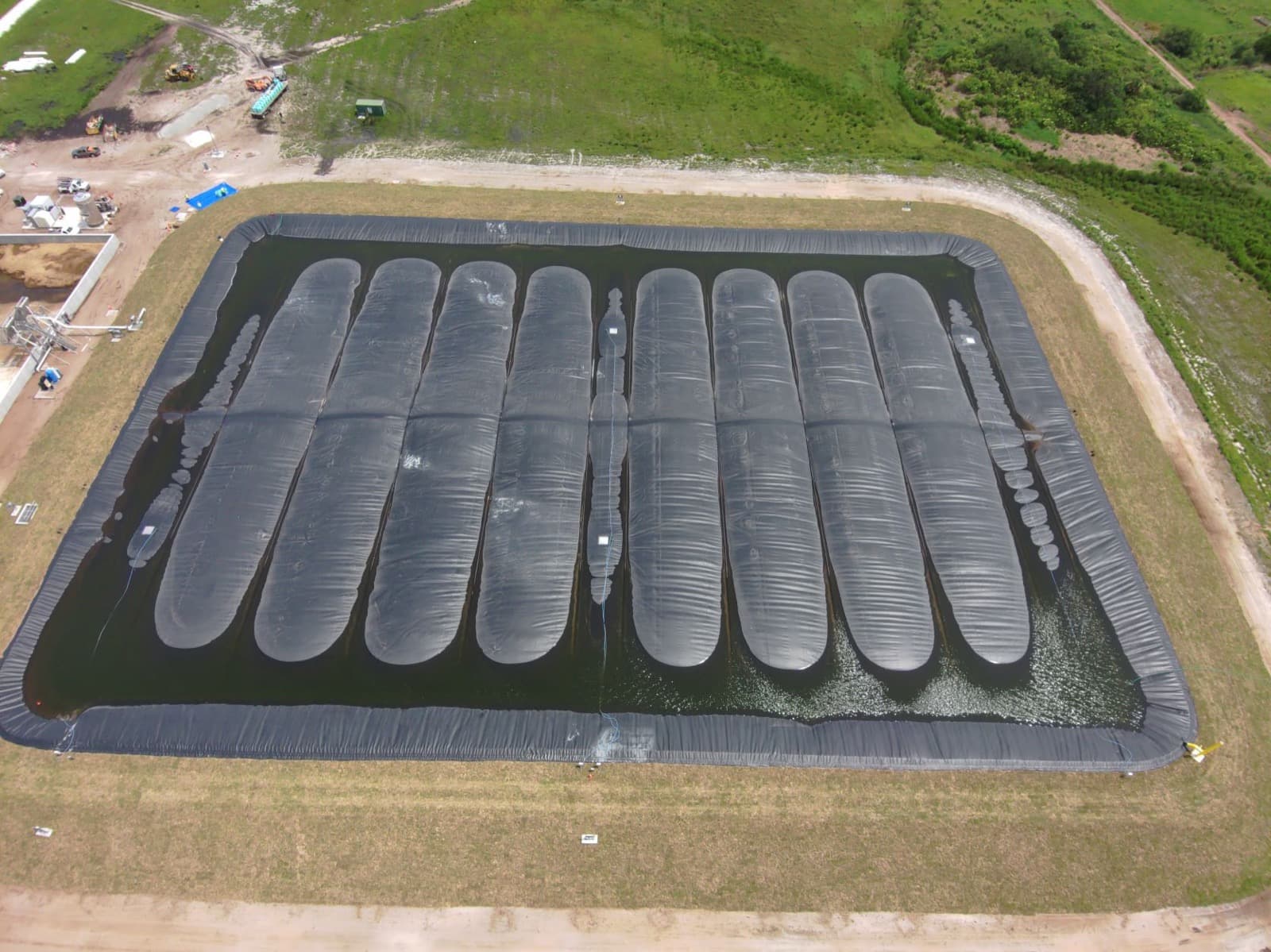
The capital cost for a complete covered lagoon digester and flare system depends on lagoon size, site conditions, and system complexity. For a 1,000-cow dairy with a standard waste lagoon, a typical installation includes the geosynthetic cover system (liner, gas collection piping, ballast), an enclosed flare rated for the expected gas flow, condensate management (knockout pots, drain lines), monitoring instrumentation (gas flow meters, temperature sensors, flare temperature monitoring), and site work (anchor trenching, piping, electrical). Total installed cost ranges from $400,000 to $900,000 for this size operation.
Smaller operations (200-500 cows) with simpler lagoons can be covered for $300,000 to $500,000. Larger operations (3,000-10,000+ cows) with multiple lagoons or complex site conditions may require $1 million to $1.5 million. These are fully installed, commissioned costs including engineering, permitting, materials, labor, and QA testing. Under EFI's zero-cost model, the operator pays none of this upfront -- but the economics still need to work for both parties.
IRR and Payback: The Actual Numbers
Across EFI's portfolio, project-level internal rates of return (IRR) range from 30% to 80%, with the median at approximately 45%. The wide range reflects variation in three key factors: methane production volume (driven by herd size, climate, and waste management), carbon credit pricing at the time of sale, and installed cost (driven by site complexity and logistics). Higher IRR projects are typically larger operations in warm climates with straightforward site conditions. Lower IRR projects (still 30%+) tend to be smaller operations, cold-climate installations with seasonal biogas variation, or sites requiring significant earthwork or sludge management.
Simple payback periods -- the time for cumulative revenue to equal the initial capital investment -- range from 1 to 4 years across the portfolio. The median payback is approximately 2.5 years. A $600,000 installation generating $250,000 annually in carbon credits achieves payback in 2.4 years. After payback, the system continues generating revenue for its remaining 20-25 year useful life with annual O&M costs of only $15,000 to $50,000. The long-tail economics are exceptional: a system that pays for itself in year 3 generates 17-22 additional years of nearly pure margin.
Sensitivity Analysis: What If Credit Prices Drop?
The most common concern from operators and investors is carbon credit price volatility. It is a legitimate risk, and EFI underwrites projects assuming conservative credit pricing. Here is how the math works at different price points for a representative 1,000-cow dairy with $600,000 installed cost and 800 tonnes/year methane destruction (22,400 tCO2e/year credits):
- Credits at $30/tCO2e: Annual revenue $672,000. Payback 0.9 years. IRR exceeds 100%.
- Credits at $20/tCO2e: Annual revenue $448,000. Payback 1.3 years. IRR approximately 70%.
- Credits at $15/tCO2e: Annual revenue $336,000. Payback 1.8 years. IRR approximately 50%.
- Credits at $10/tCO2e: Annual revenue $224,000. Payback 2.7 years. IRR approximately 35%.
- Credits at $5/tCO2e: Annual revenue $112,000. Payback 5.4 years. IRR approximately 15%.
Even at $5 per tonne -- well below any realistic long-term market scenario -- the project still achieves a 15% IRR and pays back within 6 years. The low capital base of cap-and-flare projects provides a cushion that RNG projects, with their $15-50 million cost structures, simply cannot match. A 50% credit price decline is uncomfortable but survivable for a cap-and-flare project. The same decline can bankrupt an RNG project.
Beyond Carbon Credits: Ancillary Economic Benefits
The ROI calculations above consider only carbon credit revenue. In practice, dairy operators realize several additional economic benefits that are harder to quantify but real. Odor reduction from covered lagoons can protect property values, reduce neighbor complaints that lead to legal costs, and in some cases enable operation expansion that would otherwise face community opposition. Regulatory compliance value increases as state methane regulations tighten -- an installed system avoids future compliance costs and penalties. Some operators have reported improved relationships with processors and buyers who increasingly require sustainability metrics from their supply chain.
Insurance and lending benefits are emerging as well. Several agricultural lenders have begun offering preferential terms for operations with methane management infrastructure, viewing covered lagoons as risk mitigation for environmental liability. While it is difficult to assign a dollar value to these benefits, they consistently tip the decision in favor of methane capture for operators who are on the fence about the carbon credit economics alone.
“I've never had a farmer come back after two years and say they wish they hadn't done it. The checks from carbon credits are real, the smell is gone, and the neighbors stopped complaining. That's a pretty good return on zero dollars invested.”
-- EFI USA