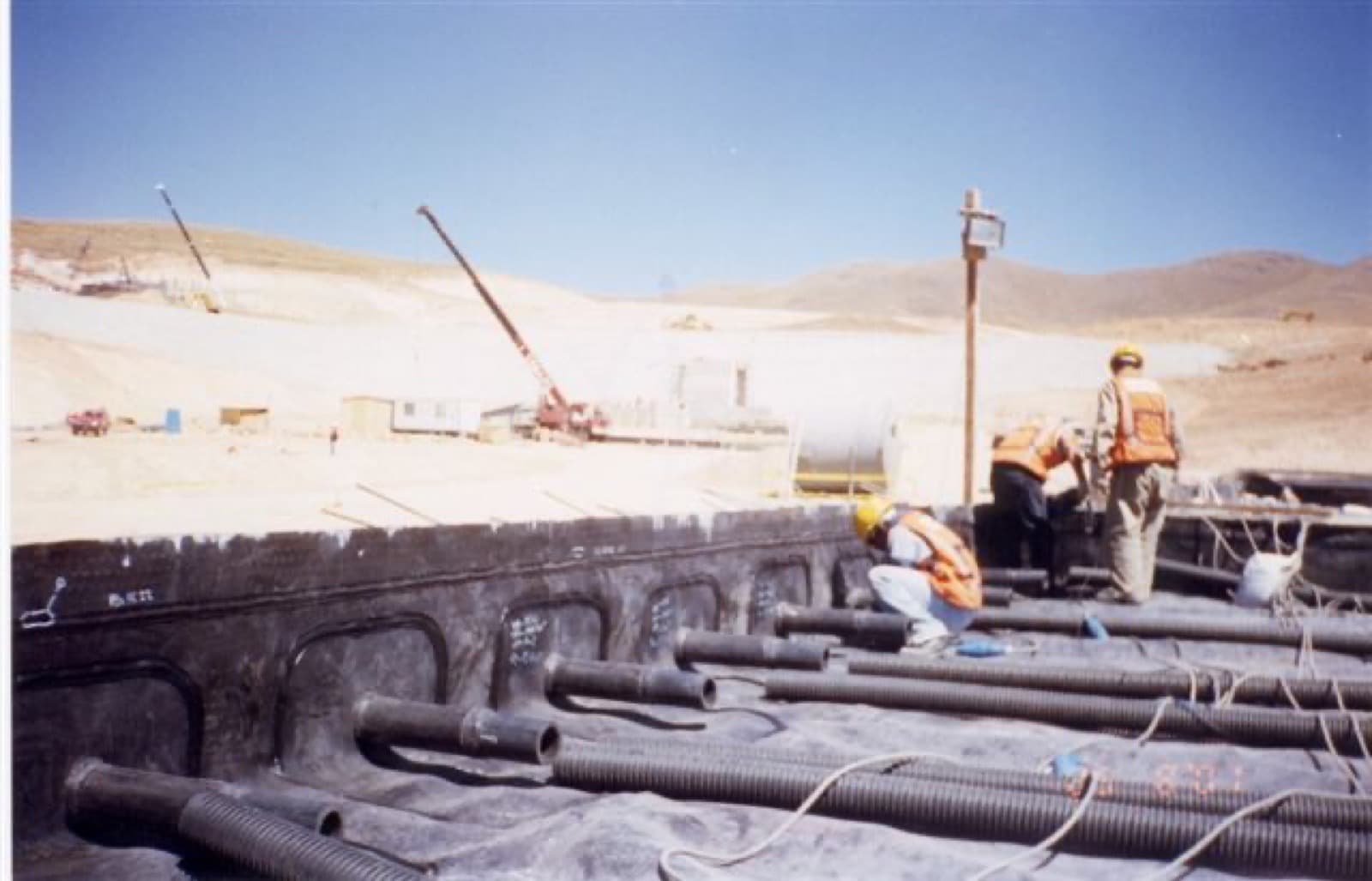
The choice between a geosynthetic clay liner and a compacted clay liner is one of the most consequential decisions in containment system design. Both serve the same fundamental purpose -- providing a low-permeability barrier to prevent fluid migration -- but they achieve it through very different mechanisms, at different price points, and with different long-term performance profiles. This comparison is intended for engineers, facility owners, and regulators who need to evaluate both options objectively.
What Is a Geosynthetic Clay Liner (GCL)?
A GCL is a manufactured hydraulic barrier consisting of a thin layer of sodium bentonite clay sandwiched between two geotextiles or bonded to a geomembrane. The bentonite layer is typically 4-6 millimeters thick and weighs approximately 0.75 to 1.1 pounds per square foot. When the bentonite hydrates, it swells to form a dense, low-permeability barrier. GCLs are factory-manufactured in rolls, typically 15 to 17.5 feet wide and 100 to 200 feet long, and are deployed on-site similarly to geomembrane panels.
The two primary GCL construction types are needle-punched and stitch-bonded. Needle-punched GCLs have fibers from the cover geotextile punched through the bentonite and into the carrier geotextile, creating a mechanical bond that provides internal shear strength. Stitch-bonded GCLs use rows of stitching to bond the two geotextiles together through the bentonite. Needle-punched products dominate the North American market because of their superior internal shear strength on slopes.
What Is a Compacted Clay Liner (CCL)?
A compacted clay liner is constructed by placing and compacting natural clay soil in lifts, typically 6 to 8 inches thick after compaction, to achieve a total thickness of 18 to 24 inches or more. The clay must meet specific gradation and plasticity requirements, and each lift must be compacted to a minimum of 95% Standard Proctor density at a moisture content 2-4% above optimum. The target hydraulic conductivity for most regulatory applications is 1 x 10^-7 cm/sec or lower.
CCL construction is fundamentally an earthwork operation. It requires a suitable borrow source, moisture conditioning equipment, compaction equipment (typically sheepsfoot or padfoot rollers), and extensive quality assurance testing including nuclear density testing, Shelby tube sampling, and laboratory permeability testing. Each lift must be tested before the next is placed.
Permeability Comparison
Hydraulic conductivity is the primary performance metric for both GCLs and CCLs. A well-constructed CCL achieves hydraulic conductivity in the range of 1 x 10^-7 to 1 x 10^-8 cm/sec. A hydrated GCL typically achieves 1 x 10^-9 to 5 x 10^-9 cm/sec -- roughly one to two orders of magnitude lower than a CCL. On paper, the GCL wins this comparison decisively.
However, permeability performance over time introduces complications. GCLs are susceptible to cation exchange -- when calcium, magnesium, or other divalent cations in the permeating liquid or adjacent soil replace the sodium in the bentonite, the clay loses its swelling capacity and permeability can increase by two to three orders of magnitude. This is a real and well-documented failure mechanism, particularly in applications where leachate chemistry is aggressive. CCLs, by contrast, tend to be more chemically stable over time, though they are vulnerable to desiccation cracking if they dry out.
Installation and Schedule
GCL installation is fast. A typical two-person crew can deploy 20,000 to 40,000 square feet of GCL per day, depending on site geometry and slope conditions. The rolls are placed with 6-inch minimum overlaps, and seaming consists simply of ensuring the overlaps are properly positioned with supplemental bentonite granules applied to the overlap zone. No welding is required. A 5-acre containment floor can be GCL-lined in 3 to 5 working days.
CCL construction is a much slower process. Depending on the clay source, haul distance, and weather conditions, a well-equipped earthwork crew can place and compact 500 to 1,500 cubic yards of clay per day. For a 5-acre containment with a 24-inch CCL, this translates to roughly 3 to 6 weeks of active construction -- an order of magnitude longer than GCL installation. Add in weather delays, and CCL construction can easily stretch a project schedule by a month or more.
Weather sensitivity differs significantly between the two options. GCL can be deployed in a wider range of conditions, though it should not be exposed to rain before being covered, as premature hydration can cause bentonite migration and panel shrinkage. CCL construction is highly weather-sensitive -- the clay must be maintained within a narrow moisture window, and rain events can shut down operations for days while the surface dries.
Cost Analysis
Material cost for GCL typically ranges from $0.40 to $0.80 per square foot, depending on product type, bentonite loading, and order volume. Installation adds $0.15 to $0.30 per square foot for labor and equipment. Total installed cost for GCL generally falls between $0.55 and $1.10 per square foot.
CCL cost is dominated by the clay source. If suitable clay is available on-site, material cost may be negligible beyond excavation and hauling. If clay must be imported, material cost alone can range from $8 to $20 per cubic yard, and a 24-inch CCL requires approximately 3.7 cubic yards per 100 square feet. Compaction, moisture conditioning, and QA testing add significant labor and equipment costs. Total installed CCL costs typically range from $2.00 to $6.00 per square foot for imported clay, and $0.80 to $2.50 per square foot when suitable on-site material is available.
- GCL installed cost: $0.55-$1.10 per square foot (typical range)
- CCL with on-site clay: $0.80-$2.50 per square foot
- CCL with imported clay: $2.00-$6.00 per square foot
- Cost crossover: GCL is almost always cheaper than imported-clay CCL, and competitive with on-site-clay CCL when schedule value is factored in
- QA testing costs are significantly higher for CCL due to per-lift density and permeability testing requirements
Thickness and Airspace
One often-overlooked advantage of GCLs is their thin profile. A GCL is roughly 6-10 millimeters thick, compared to 18-24 inches for a CCL. In landfill applications, this difference translates directly into additional airspace -- a 24-inch CCL on the floor and sideslopes of a 20-acre landfill cell displaces approximately 50,000 to 80,000 cubic yards of airspace that could otherwise be filled with waste. At typical tipping fees, this lost airspace represents millions of dollars in forgone revenue over the life of the facility.
Regulatory Acceptance
Both GCLs and CCLs are widely accepted by regulatory agencies for containment applications. The EPA's Subtitle D regulations for municipal solid waste landfills require a composite liner consisting of a geomembrane over a CCL or GCL. Many state regulations explicitly allow GCL as an equivalent component in composite liner systems. However, some older state regulations still reference specific CCL thickness requirements that may need variance approval to substitute a GCL.
For agricultural and industrial lagoon applications, regulatory acceptance varies by state. Most states accept GCL in composite systems, but standalone GCL barriers (without an overlying geomembrane) may face more scrutiny than standalone CCLs due to concerns about chemical compatibility and long-term permeability stability.
When to Choose GCL
- No suitable clay borrow source is available on-site or nearby
- Project schedule is compressed and cannot accommodate weeks of earthwork
- The liner system is a composite design with a geomembrane as the primary barrier
- Airspace conservation is economically significant (landfill applications)
- The contained liquid chemistry is benign (low divalent cation concentration)
- Site access or staging area limitations make large earthwork operations impractical
When to Choose CCL
- High-quality clay is available on-site at low excavation cost
- The contained liquid has aggressive chemistry that may cause bentonite cation exchange
- Regulations specifically require a minimum clay thickness that precludes GCL substitution
- The facility has a long design life (50+ years) and chemical exposure uncertainty
- The project is in a region where CCL construction expertise is readily available and cost-competitive
- Desiccation risk is low because the liner will remain covered or saturated at all times
Composite Systems: Using Both Together
In many high-performance containment systems, GCL and CCL are not mutually exclusive. Double-lined landfill cells, hazardous waste facilities, and high-consequence containment systems often incorporate both a GCL and a CCL as part of a multi-layer system. The GCL provides the ultra-low permeability component, while the CCL provides chemical resistance, puncture protection, and redundancy.
For most agricultural lagoon and biogas containment applications, a composite system of geomembrane over GCL provides excellent performance at reasonable cost. The geomembrane protects the GCL from chemical exposure and desiccation, while the GCL provides secondary containment and resistance to geomembrane defects. This is the configuration EFI USA installs most frequently in covered lagoon digester and cap-and-flare applications.
The right choice depends on site conditions, contained fluid chemistry, regulatory requirements, schedule constraints, and available materials. EFI USA has designed and installed both GCL and CCL systems across hundreds of projects and can provide site-specific recommendations based on your project's unique requirements.