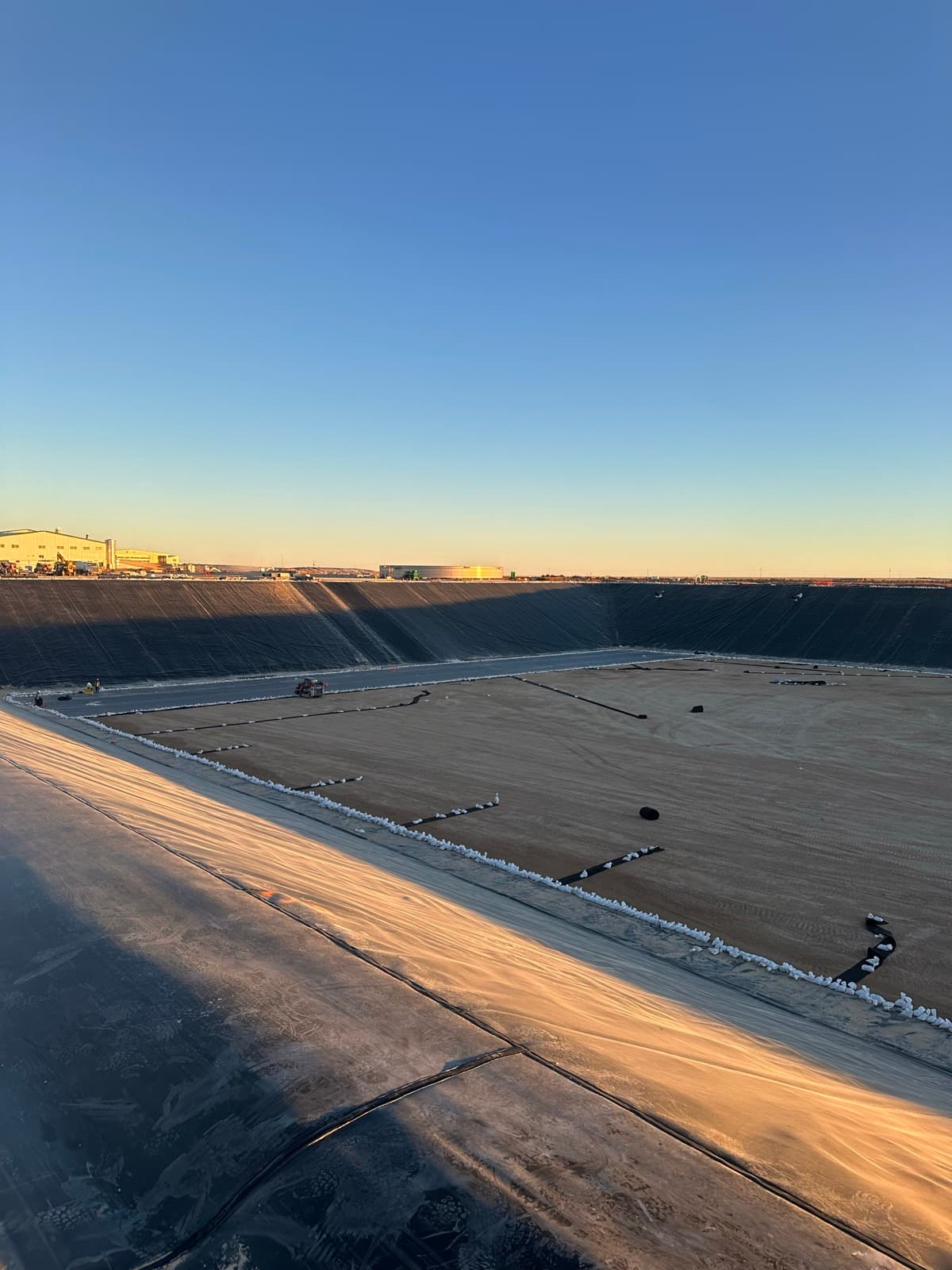
Most municipal wastewater lagoons in the United States were built between the 1960s and 1980s. The original liner systems, where liners were installed at all, have reached or exceeded their expected service life. Many early lagoons used compacted clay as the sole barrier, a material that performs reasonably well when hydrated but deteriorates once it dries, cracks, or is penetrated by root growth. Others used early-generation PVC or polyethylene liners with material properties that would not meet current ASTM specifications. When a municipality decides to reline, the scope of work extends well beyond rolling out new material.
The Problem Is Rarely Just the Liner
A failing liner is usually a symptom, not the root cause. Municipal lagoon systems that need relining have typically been in service for 25 to 40 years. During that time, sludge has accumulated on the bottom, inlet and outlet structures have corroded or shifted, and the lagoon geometry itself may have changed due to bank erosion or settlement. A liner replacement project that does not address these underlying conditions will underperform from day one.
EFI's approach begins with a full assessment of the lagoon system, not just the liner. This includes sludge depth surveys, structural evaluation of inlet and outlet piping, bank slope measurements, and groundwater monitoring data review. In many cases, the sludge volume alone determines whether the project can be phased or requires a full dewatering and cleanout before liner installation. Municipalities that skip this step often discover mid-project that sludge removal adds weeks to the schedule and significant cost to the budget.
Material Selection for Municipal Applications
Municipal wastewater presents a different chemical exposure profile than industrial or agricultural waste streams. The liner material must resist biological activity, fluctuating pH levels, and the mechanical stress of sludge removal equipment that will operate on the liner surface for years after installation. For most municipal lagoon relining projects, the choice comes down to HDPE, LLDPE, or reinforced polypropylene (RPP), each with trade-offs in chemical resistance, flexibility, and long-term durability.
HDPE offers the highest chemical resistance and is the default for lagoons with aggressive influent chemistry. LLDPE provides greater flexibility and conformability, which matters in lagoons with irregular subgrades or ongoing settlement. RPP is lighter, easier to deploy, and performs well in applications where UV exposure is a factor, such as lagoons that are not covered. The material decision should be driven by site-specific conditions, not by default specifications carried forward from a previous project at a different facility.
Subgrade Conditions in Existing Lagoons
New construction allows the contractor to build the subgrade to specification from scratch. Relining projects do not have that luxury. The existing lagoon bottom and side slopes have been exposed to decades of biological and chemical activity. Clay subgrades may have desiccated and cracked during temporary dewatering events. Sand or gravel subgrades may have shifted. Root intrusion from surrounding vegetation is common on lagoon berms that were not maintained with root barriers.
EFI typically specifies a geotextile cushion layer beneath the new liner in relining applications. This serves two purposes: it protects the geomembrane from subgrade irregularities that cannot be economically corrected, and it provides a drainage path for any groundwater that might otherwise create uplift pressure beneath the liner. Hydrostatic uplift is one of the most common failure modes in lagoon relining. If groundwater levels rise above the liner elevation during a dewatering event, the liner can balloon upward and separate from the subgrade. A properly designed underdrain system prevents this.
Maintaining Operations During Construction
Municipal wastewater does not stop flowing because a lagoon is under construction. Most relining projects must be sequenced to keep the treatment system operational. For multi-cell lagoon systems, this typically means relining one cell at a time while routing flow through the remaining cells. For single-cell systems, temporary bypass pumping or diversion to a neighboring treatment facility may be required.
The sequencing plan affects everything from construction schedule to material staging to crew sizing. A project that can dedicate the full site to construction moves faster than one where the contractor is working in a confined area adjacent to an active lagoon. EFI develops the construction sequencing plan as part of the engineering submittal package, not as a field decision. Getting this wrong creates conflicts between construction activity and plant operations that are expensive to resolve.
Regulatory and Permitting Realities
Municipal lagoon relining projects require coordination with state environmental agencies, and the permitting requirements vary significantly by jurisdiction. Some states treat a relining as routine maintenance under the existing facility permit. Others require a modified construction permit with updated engineering plans, liner specifications, and a construction quality assurance plan. A few states require a hydrogeological assessment to demonstrate that the new liner system meets current groundwater protection standards, even if the original lagoon was permitted under less stringent requirements.
EFI has completed municipal lagoon projects across multiple states and understands the permitting landscape. The time required to secure permits can equal or exceed the construction duration itself. Municipalities that begin the permitting process concurrently with engineering design avoid the most common schedule delay in lagoon relining projects.
What Separates Good Outcomes from Bad Ones
After three decades of municipal installations, the pattern is clear. Projects that invest in thorough upfront assessment, proper material selection, and realistic construction sequencing deliver liner systems that perform for 20 to 30 years with minimal maintenance. Projects that cut corners on subgrade preparation, skip the sludge survey, or select materials based on lowest initial cost generate warranty claims, premature repairs, and regulatory scrutiny within the first five years.
The difference is not dramatic on paper. It shows up in details: whether the geotextile cushion was specified, whether hydrostatic uplift was addressed in the design, whether the construction sequencing allowed adequate cure time for anchor trench backfill. These are decisions that require field experience with municipal lagoon systems specifically, not just general geosynthetic installation experience. EFI has been doing this work since 1993, across every type of municipal and industrial lagoon in the eastern United States. The lessons are in the details, and the details are what make the system last.