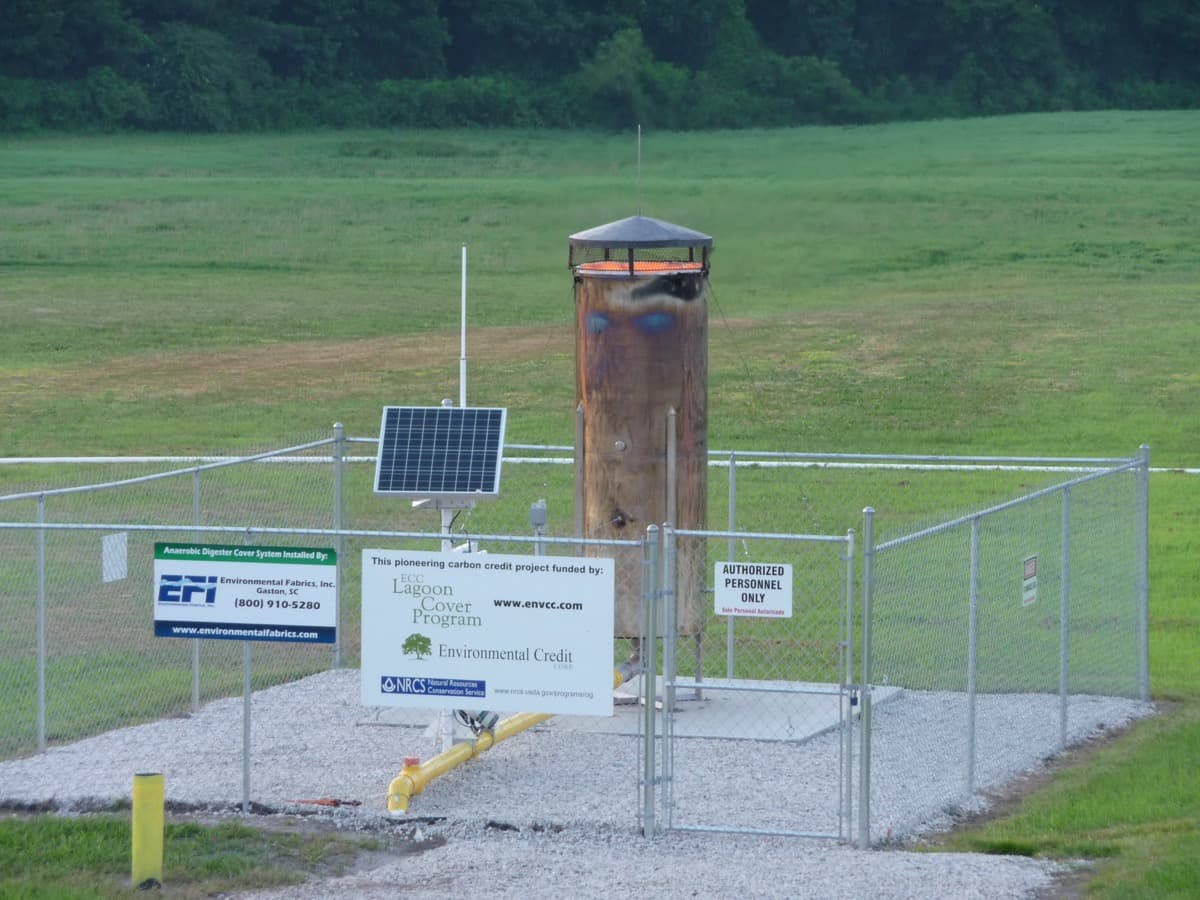
Biogas leaving a covered lagoon at 95 degrees is saturated. About 5.5 percent of what a meter sees at the cover penetration is water vapor rather than gas. Send that same stream a few hundred feet down a buried header, let it cool to 60 degrees, and roughly 22 gallons a day per 100,000 standard cubic feet have come out as liquid. A second meter downstream of the knockout will read lower than the first one. Neither instrument is broken.
That is the ordinary case, and it is where most arguments about gas numbers start. The reading matters more than its cost on a bid sheet suggests. Carbon programs pay on destroyed methane, gas offtake settles on delivered energy, and a flare permit is written against a throughput the operator has to be able to show. All of it comes from a flow reading multiplied by a composition reading. Three percent of error is three percent off the top for the life of the asset.
Wet Gas, Dry Gas, and What Standard Means
A meter reporting wet volume on that 95 degree stream reports more gas than the project has, because part of the stream is water on its way to becoming liquid. Multiply through at 60 percent methane and a site reporting wet where the protocol wants dry is claiming close to 22 tonnes of methane a year it did not destroy. Verifiers do not treat that as a rounding difference.
Reference conditions are the other half. In the United States a standard cubic foot is 60 degrees Fahrenheit at 14.696 psia. Elsewhere the same gas gets reported in normal cubic meters at zero degrees Celsius, or in standard cubic meters at fifteen, and those two sit about 5.5 percent apart before anyone touches the gas. EFI has built more than 300 covered lagoon digesters across Mexico and Central America, and on international work this shows up constantly as two engineers producing different totals from one meter, each correct in their own units. Every gas number that leaves the site should carry its basis and its reference conditions with it.
What Each Meter Type Is Actually Measuring
Thermal mass meters measure how much heat a flowing stream carries away from a heated sensor, then convert that to mass flow using the thermal properties of the gas they were calibrated on. Calibrate for 60 percent methane and 40 percent carbon dioxide, run a lagoon that drifts to 55 and 45 through a cold spell, and the meter reports the drift as flow. The sensor also sits directly in the stream, where biogas coats it. Turndown is excellent, which is why these are common on lagoons, but they need a clean calibration story.
Differential pressure meters, whether a square edged orifice or an averaging pitot, infer velocity from a pressure drop and then need density to reach mass. Density needs composition, temperature and pressure. That error enters under a square root, which softens it: a shift from 60/40 to 55/45 raises actual density about 5 percent and puts about 2.5 percent into the flow reading if nothing compensates. Softening an error is not removing it, and 2.5 percent compounds across twenty years of reporting.
Vortex meters need enough velocity to shed a clean signal and go blind below their Reynolds threshold, which on a lagoon means the winter months when production is already lowest. Transit time ultrasonic meters put nothing in the stream, hold a wide turndown, and read speed of sound as a byproduct, which gives an independent check on composition. They cost more up front. Where the gas number is the revenue, that is usually the right trade.
Inches of Water Column Change the Calculus
Gas under a floating cover sits at a few inches of water column, and one psi is 27.7 inches, so the whole driving pressure of the system is a small fraction of a pound. Permanent pressure loss across a square edged orifice runs somewhere between half and four fifths of the differential it measures. Set that meter up for two inches of differential and the cover permanently gives back one to one and a half of the inches it had to work with. Back pressure of that order lifts a cover, loads the perimeter seal, and sends gas out the weakest penetration instead of to the flare.
Straight run is the constraint that gets designed away. Manufacturers ask for ten to twenty pipe diameters upstream and five downstream. In a retrofit gas train squeezed between a cover penetration and a blower skid on an existing pad, that run frequently does not exist, and the element ends up four diameters off an elbow because that is where the pipe was. It still reports a number, against a velocity profile it was never calibrated for.
Where the Meter Goes in the Train
The most stable place for a flow element is downstream of the moisture knockout and upstream of the blower. The gas there has given up most of its water, it is near ambient temperature, and it is still at a known low pressure. Move the meter to the blower discharge and the stream is hotter and pressurized, so an actual cubic foot holds more gas than it did on the suction side. Fine if the instrument compensates for temperature and pressure, a straightforward overstatement if it does not.
The rest is plumbing discipline. Slope the run so condensate reaches the drip legs instead of pooling under the meter, keep the element on a horizontal section with the longest approach available, and assume hydrogen sulfide and the elemental sulfur that follows treatment will deposit on any surface left in the stream. A probe caked after a season of service usually explains a drift that has been blamed on the lagoon.
What to Put in the Specification
- Reference conditions and wet or dry basis printed on the meter datasheet and repeated on every report the site issues.
- The composition the meter is calibrated for, and a written answer for what the reading does when actual composition moves off it.
- Live temperature and pressure compensation rather than fixed values entered once at commissioning.
- Turndown checked against the site's real winter minimum and summer peak, not against the catalog ratio.
- Calibration interval, who performs it, and what the record looks like when a verifier asks for four years of it.
- Physical access to pull, inspect and clean the element without taking the flare offline.
EFI has been building covered lagoon and biogas systems from Gaston, South Carolina since 1993, with more than 500 covered lagoon digester systems installed and roughly 82 percent of the US covered lagoon market. The flow meter is one of the smaller line items on any of those gas trains, and it is the only component whose output the owner hands to a regulator, a verifier and a buyer. When an operator calls about two instruments that disagree, the cause is rarely a failed meter. It is two correct instruments reporting on different bases, and the fix is a conversation about reference conditions rather than a purchase order.