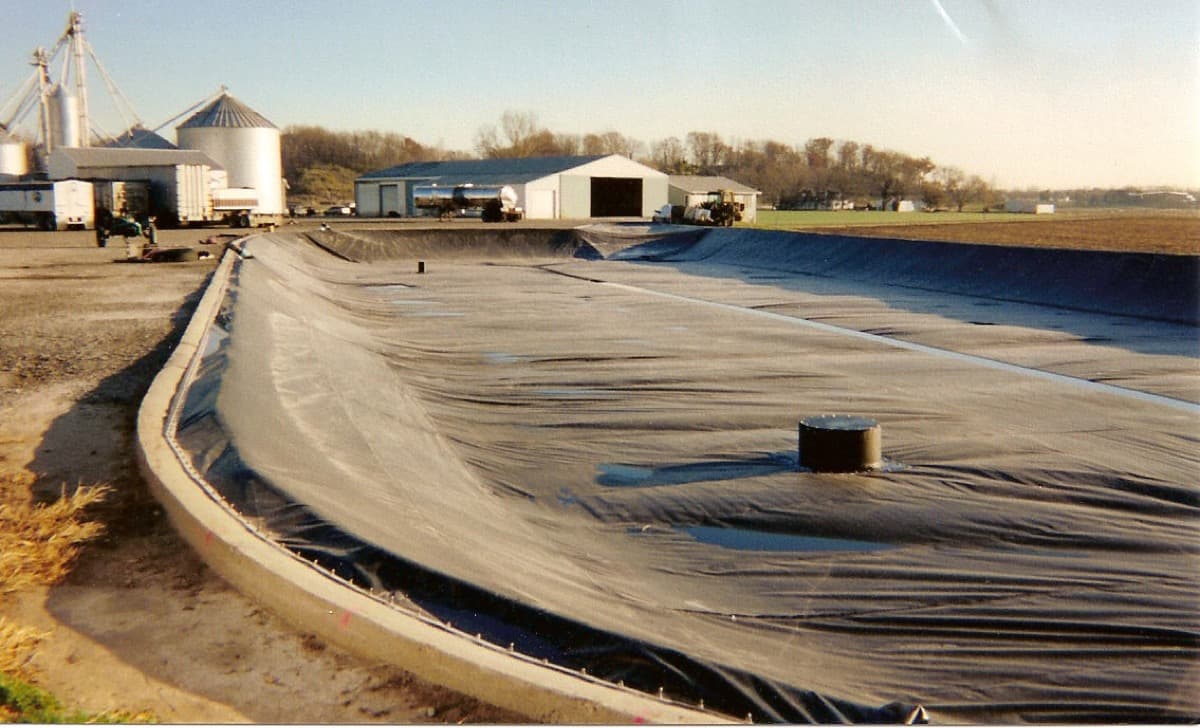
Almost every conversation about pressure under a gas-tight lagoon cover is about the top of the band. Gas accumulates, the cover domes up, the seams and the anchor take the load, and a relief device opens before anything is damaged. That side of the problem is well understood and it is designed for on every job. The low side of the band gets far less attention, and it is where a cover can be pulled out of shape in an afternoon by equipment that is doing exactly what it was told to do.
The numbers are small enough to be deceptive. One inch of water column is 5.2 pounds per square foot. A gas-tight cover normally sits within a few inches of water column of atmospheric pressure, positive, and the entire gas train is designed around that. A blower on a biogas skid can develop tens of inches of water column against a closed suction. The equipment on the downstream end is capable of an order of magnitude more differential than the membrane is ever meant to see.
Where the vacuum comes from
A cover goes negative whenever gas is withdrawn faster than the basin produces it. That is not an exotic condition. Gas production falls with temperature, with a feed interruption at the plant, and for a stretch after a cleanout. A blower or an engine sized on summer production keeps pulling at its setpoint through all of it.
Liquid level does the same thing from the other direction. Pumping a lagoon down for irrigation creates new headspace volume faster than a slowed basin can fill it, so a drawdown scheduled by the farm side and a blower controlled by the gas side can work against each other for days without anyone connecting the two.
The third case is a control that never modulates. If the blower runs at a fixed speed and the only interlock is a high pressure trip, there is nothing in the logic that recognizes low pressure as a condition worth acting on.
What the membrane actually does
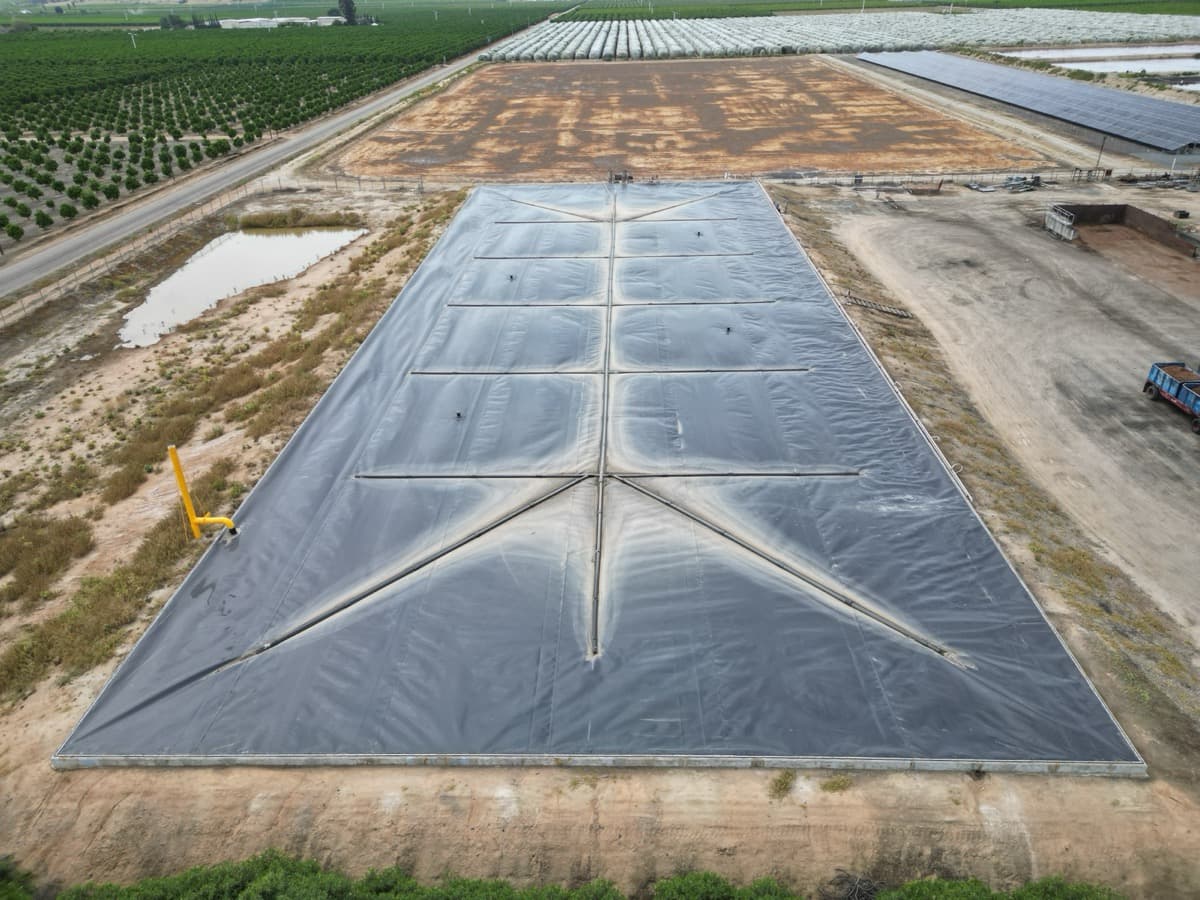
A floating cover under vacuum does not tear. It pulls flat, then down onto the liquid surface, and the load transfers to the two places that were never meant to carry it in that direction: the perimeter attachment and every penetration through the sheet. Ballast weights and the rainwater sump layout, which govern behavior on the positive side, contribute nothing here. Weight is only useful against lift.
The damage that follows is rarely dramatic. A boot at a pipe penetration gets worked loose. A batten strip at the perimeter takes a load path it was not detailed for. What comes out of it is a leak path, and under negative pressure a leak path does not vent gas out. It draws air in.
Air intrusion is the hazard, not the deformation
Methane burns in air between roughly 5 and 15 percent by volume. Raw biogas at about 60 percent methane sits well above the upper limit, which is why a headspace full of biogas is not itself an ignitable mixture. Pull air into that headspace and the mixture moves toward the flammable range from the rich side, and it passes through it somewhere: at the mixing front under the cover, in the piping, or at the flare where there is already an ignition source.
The entry points are the ordinary ones. Pipe penetration boots and the perimeter attachment are the two the vacuum itself opens up. The one that gets missed is a condensate trap that has lost its seal. A dry trap is an open pipe to atmosphere, and a gas system under negative pressure will find it immediately. Sample ports, hatches and older repair patches round out the list.
The water seal is the protection and also the blind spot
Most low pressure protection on a covered lagoon is a water seal, a leg of water in a pot or a U-tube that breaks and admits air or vents gas once the differential exceeds the depth of the leg. The depth of that water column is the trip point, in both directions, and it is the whole device. There is nothing else in it.
Which means the trip point moves when the water does. A leg that evaporates through a hot dry stretch trips early and low. A leg that freezes does not trip at all. Neither condition announces itself, and a seal pot that has emptied looks exactly like one that is holding. Put the seal level on the same inspection round as the condensate traps, and heat trace it anywhere the traps are heat traced.
How an owner sees it happening
Measure pressure at the cover. A transmitter at the blower suction reads the piping between the two, and the piping is where the plugs and the closed valves live, so on a bad day it reads nothing like the headspace it is supposed to protect.
The visible tell is a cover lying flat and drum tight against the liquid while the blower is running, which reads as a cover with no gas in it and gets reported as a production problem. Gas composition will not settle the question on a micro-aerated site, because those systems put oxygen and nitrogen into the headspace on purpose, and an oxygen reading that would be conclusive somewhere else proves nothing there. The pressure trend is the evidence.
What to design in
Size the vacuum relief for the full capacity of the blower rather than for expected demand. The case that matters is full suction applied to a basin that has stopped producing, and by definition that case is not the one anybody expected.
Write low pressure into the control narrative as an alarm and a blower cutout before commissioning. Adding it at that stage is a line in a program. Adding it after a cover has been pulled down and a boot has been reworked costs a shutdown.
Then tell the farm side and the gas side about each other. A drawdown plan and a gas system setpoint are the same decision on a covered lagoon, and on most sites they are made by two different people who have never had the conversation.
EFI has built covered lagoon and digester systems from Gaston, South Carolina since 1993, with more than 500 systems in service and roughly 82 percent of the US covered lagoon digester market. We build the liner, the cover and the gas collection on the same job, which is the only reason any of this is one conversation instead of three. A cover that never sees the low side of its pressure band lasts as long as its material does. The ones that do not, do not.