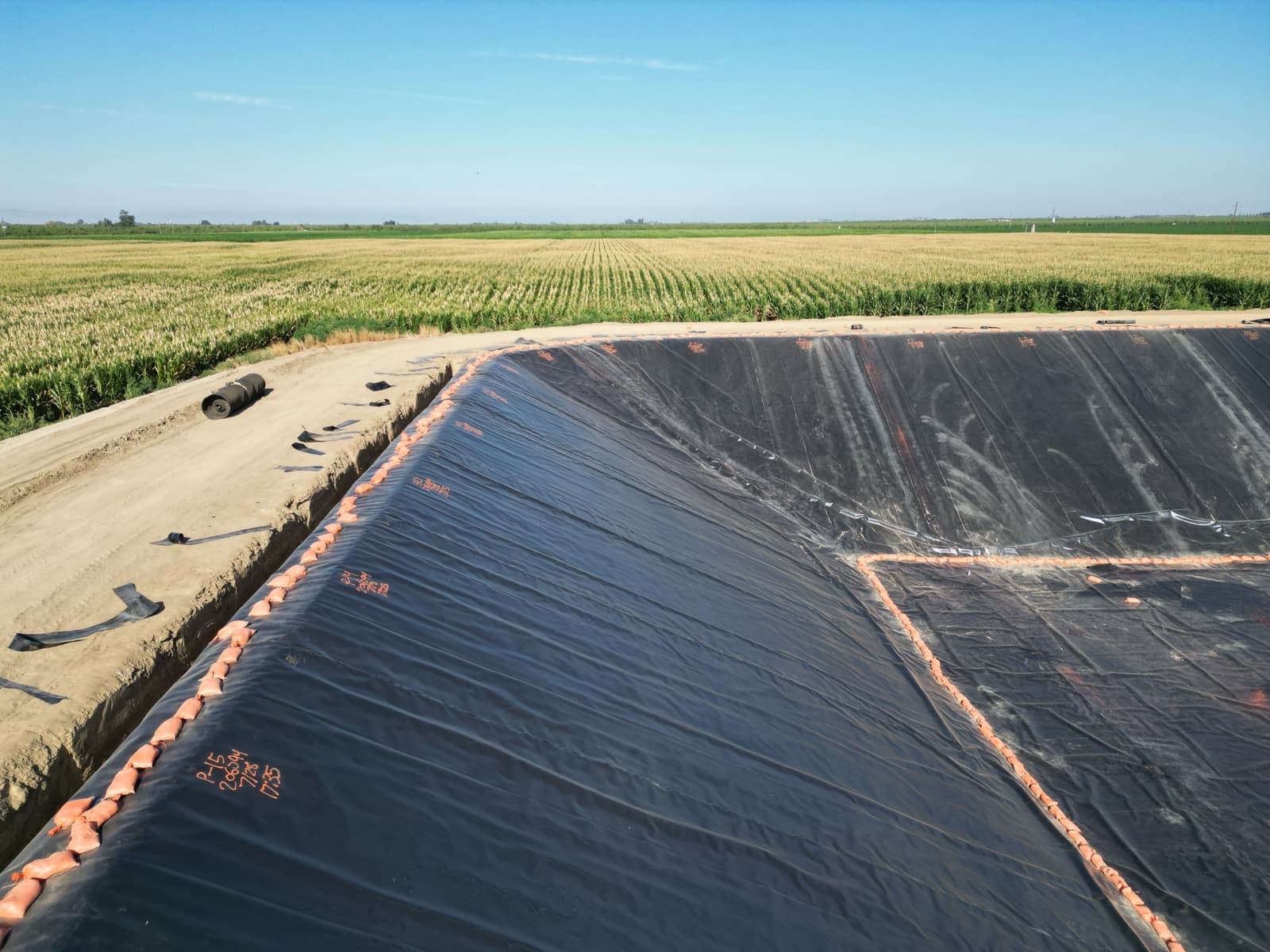
A 60 mile per hour wind moving across a flat surface develops a velocity pressure of about 9 pounds per square foot (psf). A 60-mil HDPE floating cover weighs about 0.3 psf. On paper the wind wins by more than thirty to one, and yet covers ride out storms every year without leaving the basin.
The reason is what sits under the sheet. Knowing where that support ends is most of what wind design on a floating cover comes down to, and it tells an owner exactly where to look once a storm has passed.
The numbers
Velocity pressure scales with the square of wind speed. Using the standard relationship of 0.00256 times the speed in miles per hour squared, 40 mph works out to about 4 psf, 60 mph to about 9, and 90 mph to about 21. Suction on a low, flat surface peaks just downwind of the leading edge, where the flow separates as it comes over the berm crest. Building codes such as ASCE 7 assign higher suction coefficients to roof edges and corners than to the field for the same reason.
On a gas-tight cover the useful unit is water column. One inch of water column is 5.2 psf, so the suction from a 90 mph gust is roughly 4 inches of water column. A gas-tight cover normally operates within a few inches of water column of atmospheric pressure. A storm can put a load on the sheet the same size as the entire pressure band the gas system was designed around.
Where the liquid holds the cover, and where it does not
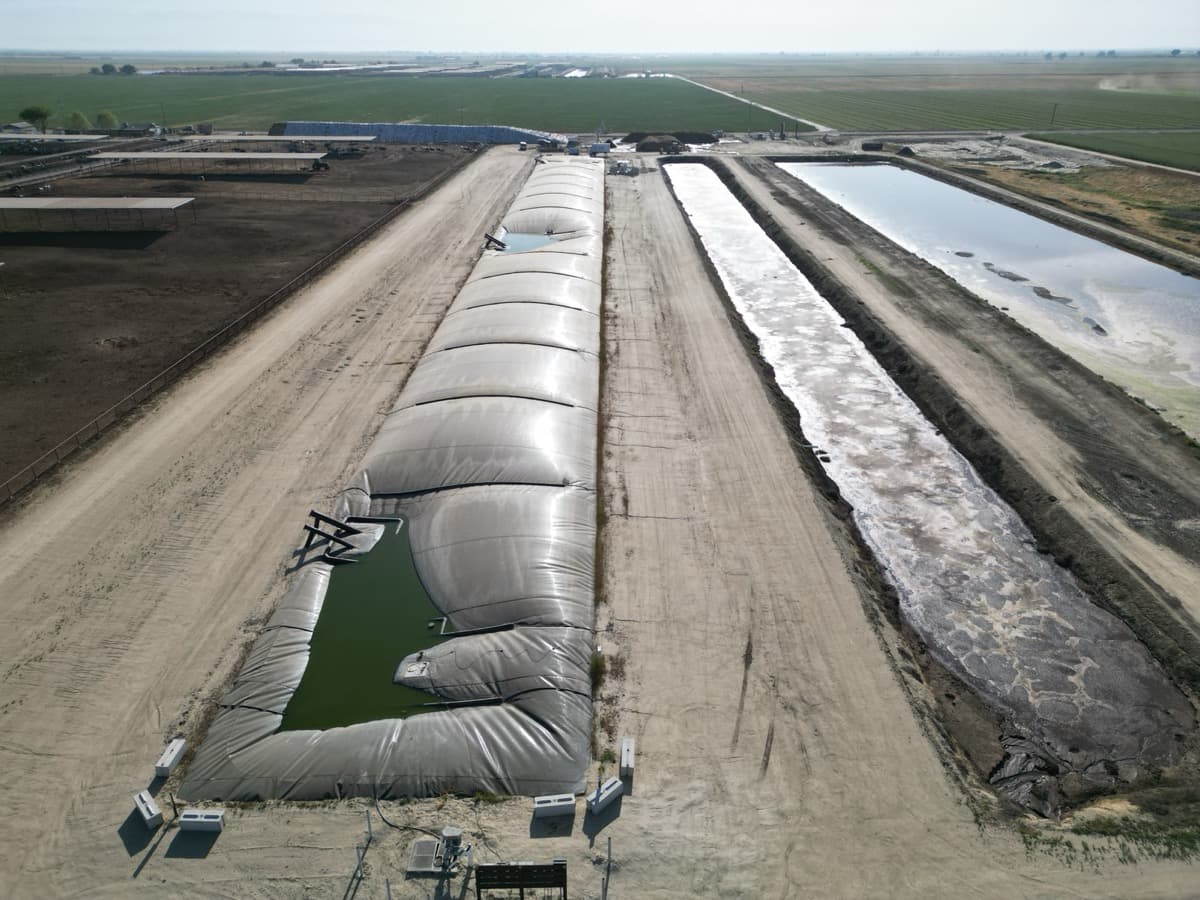
Across the part of the cover floating in full contact with the liquid, suction cannot lift the sheet without lifting the liquid too, or without air or gas getting into the gap. The liquid can shift toward the zones of highest suction, which is why a cover ripples in a storm, but it cannot rise across the whole basin at once. The field of a well-ballasted cover mostly moves in place.
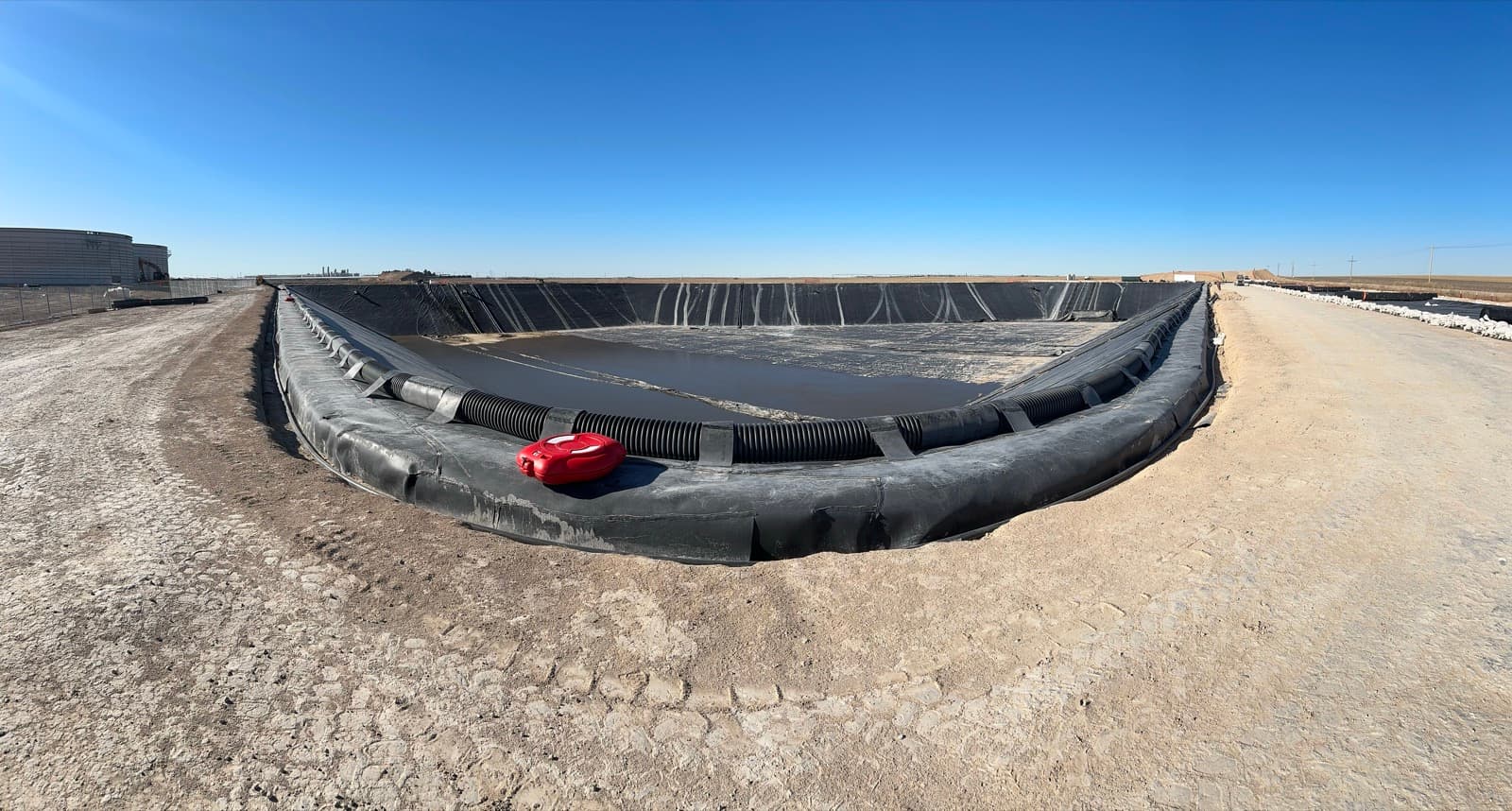
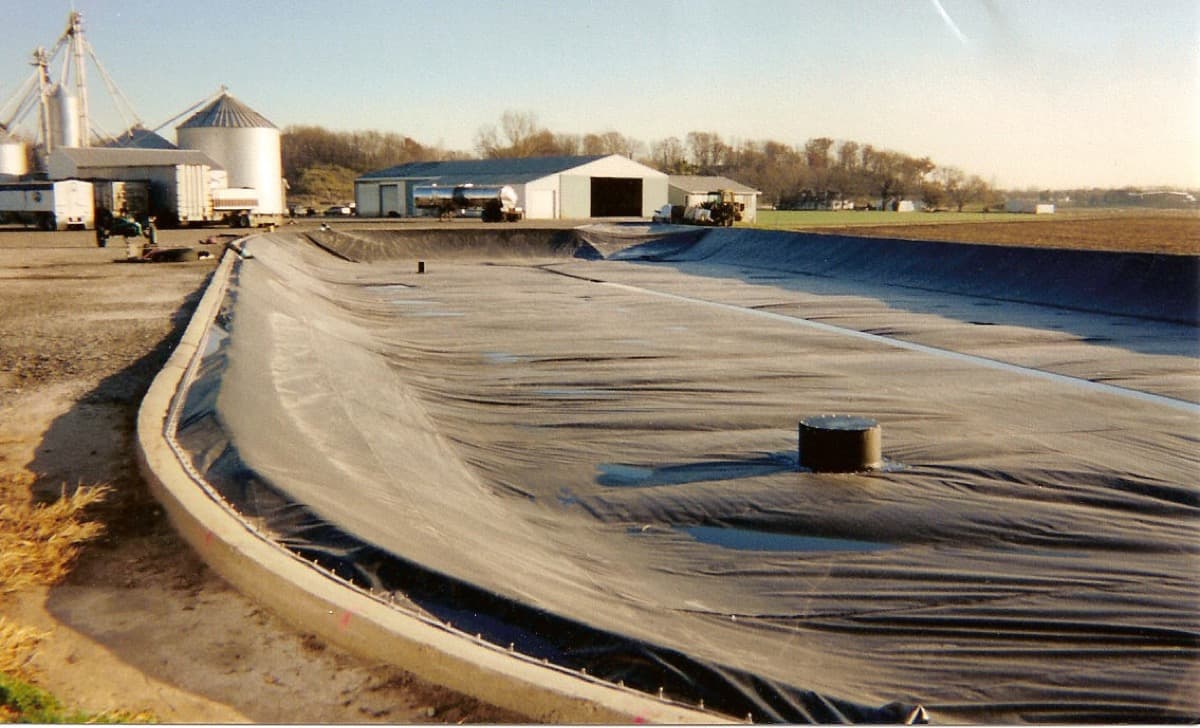
Two zones have no liquid under them. The first is the freeboard slope, the band between the operating liquid level and the anchor trench, where the cover drapes over the berm with only air or gas beneath it. The second is the gas volume on a gas-tight cover, where the sheet is domed over biogas at a slight positive pressure and wind suction adds directly to the lift the gas is already applying.
Those two zones carry the wind load. On the upwind perimeter, peak suction sits directly over the freeboard slope, and that is where storm damage concentrates.
Ballast and the anchor trench do different jobs
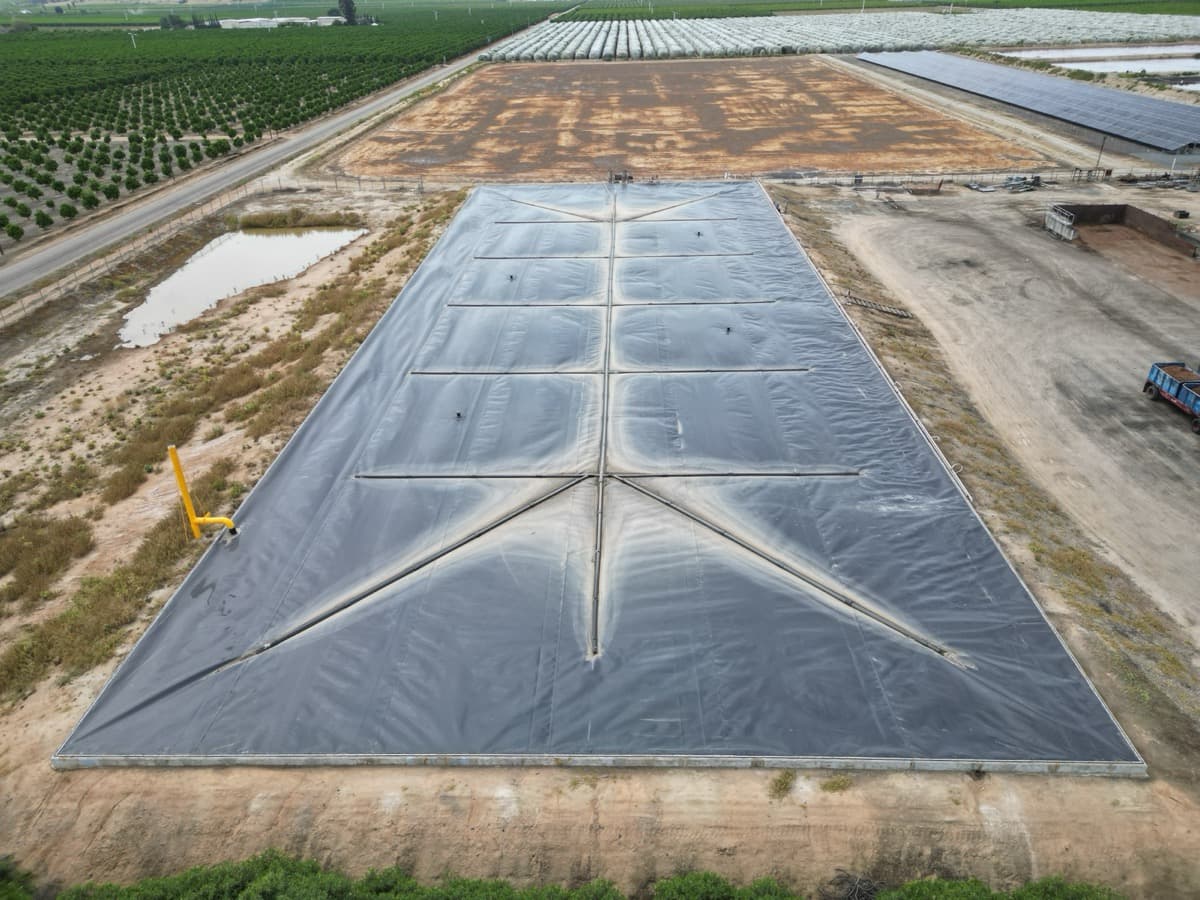
Ballast pipes and sand tubes hold the cover down on the liquid and form the troughs that carry rainwater to the sumps. They are not sized to hold an unsupported sheet against wind on their own. As an illustration, a ballast line on 20 foot spacing resisting 9 psf over its tributary width would need to weigh about 180 pounds per foot. A sand-filled 12 inch pipe weighs under 100.
What ballast does is keep gas and air from collecting under the field, which keeps the liquid doing the work. On the slopes, the load goes to the anchor trench, and its capacity comes from runout length, trench depth, and backfill compaction. On a site with a long fetch across open cropland, the upwind trench deserves the most conservative detail on the job.
Operations change the exposed area
The freeboard band is not fixed. Every foot of drawdown exposes more slope with nothing under it. A lagoon pumped down hard for fall irrigation or a sludge cleanout can go into storm season with far more unsupported cover than it has at operating level.
Gas inventory works the same way. A cover carrying a large gas bubble presents a taller profile to the wind and has less of its area resting on the liquid. Drawing the headspace down ahead of forecast high winds reduces both. The drawdown should stop well short of zero, because pulling a gas-tight cover negative opens the air intrusion problem described in our post on vacuum under floating covers.
Before a forecast high wind event, a covered lagoon operator should:
- Check the liquid level against the design operating level and postpone any further drawdown.
- Bring headspace pressure toward the low end of its normal band through the flare, without taking it negative.
- Walk the upwind perimeter for loose batten, displaced ballast, and anchor trench backfill that has settled or washed out.
- Clear loose material off the berm crest, since debris driven across a cover at storm speed is a puncture source.
Flutter does the damage slowly
Most wind damage is not a cover lifting out of the basin. It is fatigue. A sheet that lifts and drops thousands of times in a storm flexes hardest where it is held: the batten strip at the perimeter, the connection to a ballast pipe, and the boot at every penetration. The open sheet between those points moves freely and rarely fails.
That is the same short list of locations where leaks turn up in an installed cover. A post-storm inspection should start at the upwind perimeter and the penetrations, then check the gas analysis for oxygen and nitrogen, which appear when a restraint point has opened enough to let air in.
During installation there is no liquid at all
The period of greatest exposure comes before the cover is sealed and floating. Loose panels on a berm have nothing under them, and deployment stops once wind reaches roughly 15 to 20 mph because panels can no longer be controlled or welded reliably. Panel edges that are not welded by the end of a shift are weighted with sandbags, and an open anchor trench stays weighted until it is backfilled.
What this means for an owner
Wind performance on a floating cover is settled in details nobody looks at after startup: the upwind anchor trench, a ballast layout that keeps the field on the liquid, the batten and boot details at each restraint point, and a drawdown plan that accounts for the season. EFI USA engineers calculate the wind case alongside the rainwater dead load on each cover and detail the perimeter to match.
EFI USA has designed and built covered lagoon systems from Gaston, South Carolina since 1993, with more than 500 covered lagoon digester systems installed and roughly 82 percent of the US covered lagoon digester market. When a storm does get under a cover, EFI dispatches repair crews within 24 to 48 hours from its regional hubs in South Carolina, Texas, and California. Because EFI builds the liner, the cover, and the gas collection on the same job, the team that sized the anchor trench and set the gas system pressures is the same team that answers the call after the storm.