Every pound of water that evaporates off an open lagoon takes a little over 1,000 BTU of heat with it. For an aerobic pond that is just weather. For an anaerobic treatment cell, that heat is what keeps the process running.
A gas-tight floating cover stops evaporation and with it most of that loss. An insulated cover goes a step further and slows the heat moving out through the sheet itself. EFI has built insulated covers in central Minnesota and in upstate South Carolina, and the two jobs show when the extra layer earns its place.
Why temperature matters under the cover
The microbes that break down organic waste and make methane in an anaerobic cell are sensitive to temperature. Heated digesters are usually held in the mesophilic range, around 95 to 100 degrees F. Covered lagoons and anaerobic pretreatment cells usually run unheated, at whatever temperature the wastewater and the weather give them.
A common rule of thumb in biological treatment is that reaction rates roughly halve for every 18 degree F (10 degree C) drop. A cooler cell keeps working, but it does less with the same volume. More organic load passes through untreated, and gas production falls.
Wastewater from a meat or by-products plant often arrives warm. The job of the cover is to keep that heat in the basin. An open surface loses it to evaporation, to wind moving across the water, and to radiation on clear nights. A cover blocks the first two. What remains is conduction through the cover, plus losses through the berms and floor.
What the insulation layer adds
An insulated floating cover carries a layer of closed-cell foam along with the geomembrane. The foam slows heat flow through the sheet, and it also makes the cover more buoyant.
That buoyancy changes the design. The cover rides higher on the liquid, so ballast has to be sized to hold the shape that leads gas to the collection piping. Rain troughs and sumps behave differently on a stiffer, more buoyant sheet. The foam has to be closed-cell, so that water reaching it through a damaged top layer does not soak in and add weight.
Insulation changes winter behavior too. An uninsulated cover over warm liquid melts snow from below. An insulated one holds that heat in, so snow can sit on top longer and the snow load needs to be planned for. On the other side, the underside of the cover stays warmer, which cuts down on condensation inside the sheet.
Long Prairie, Minnesota, 1997
Central Bi-Products runs an animal by-products plant in Long Prairie. By 1997, increased production had overloaded its wastewater treatment plant. Rein and Associates handled the process design and Lightowler and Johnson the civil design. Their answer was a new covered anaerobic cell ahead of the existing plant, to pretreat the wastewater and take load off the plant downstream.
The plant sits near a river, so the specification called for a 60-mil HDPE liner to protect groundwater. For the cover, the designers chose insulated 60-mil HDPE. EFI's case history lists its purposes plainly: seal the cell, improve the anaerobic process, capture methane and keep odors in. EFI did the geomembrane work, starting in late summer and finishing on schedule.
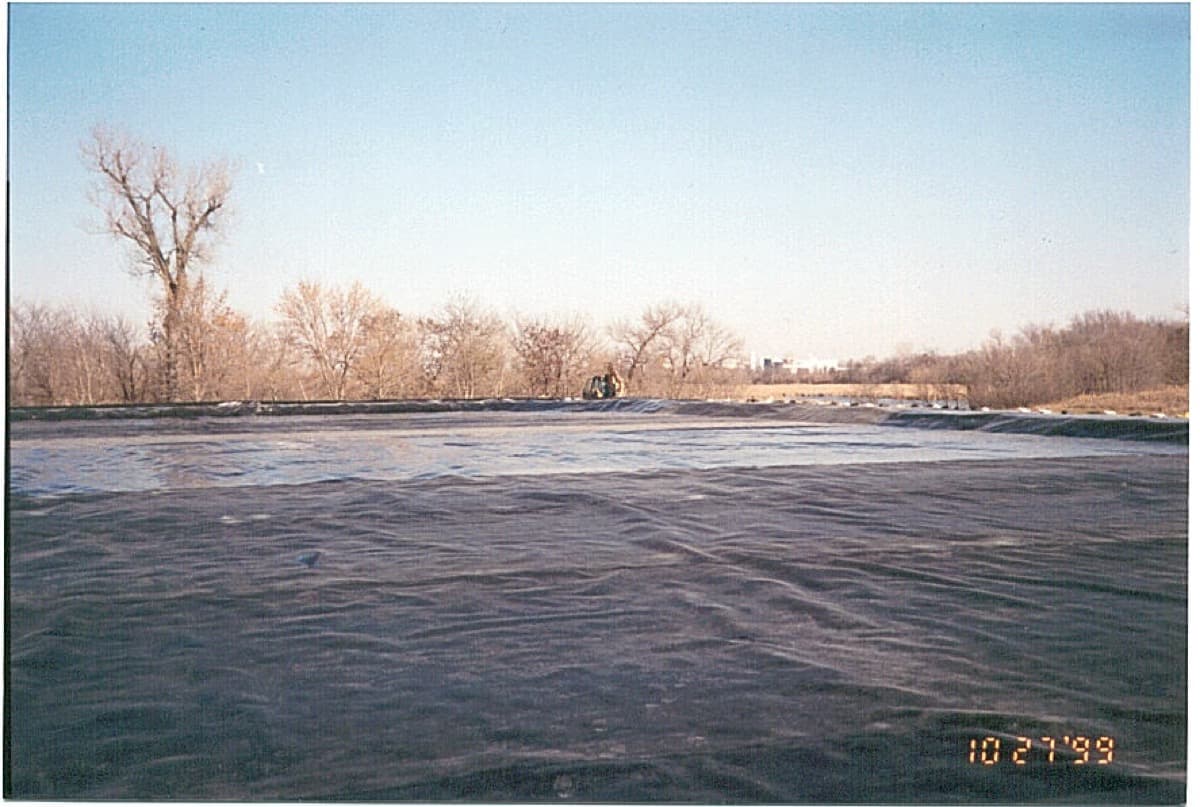
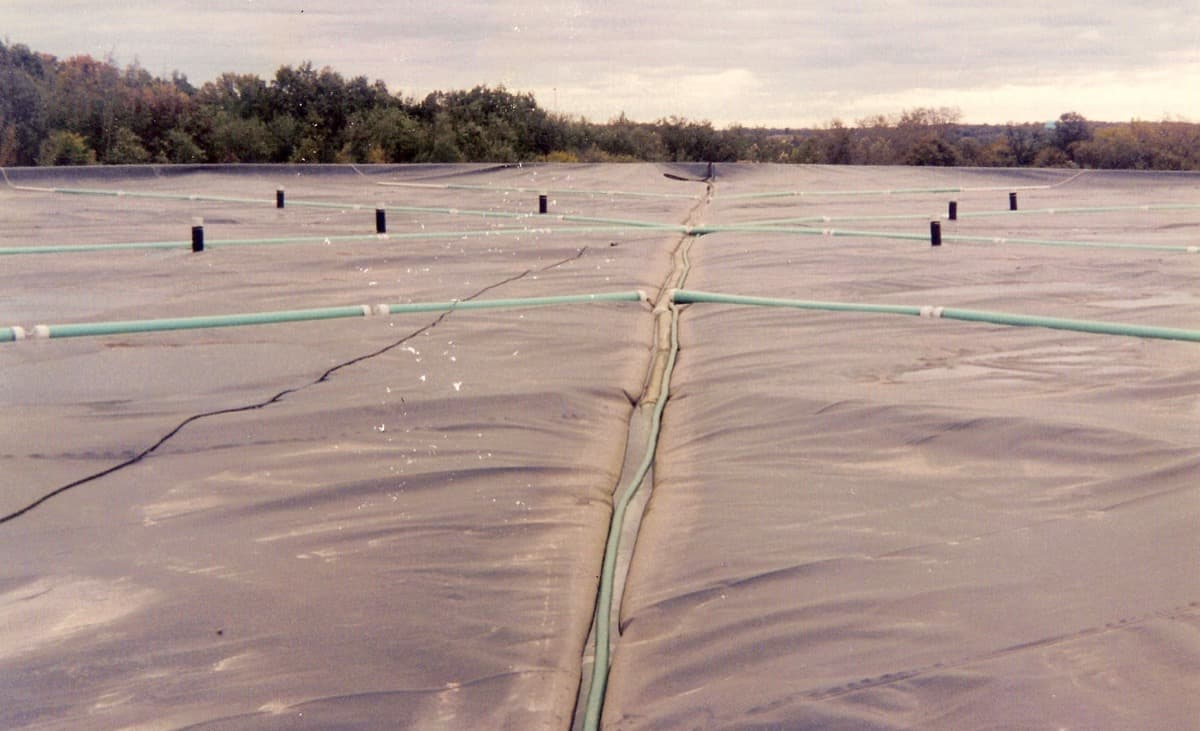
Central Minnesota winters are the obvious reason to insulate. A pretreatment cell that slows down every January sends its load straight to the plant it was built to protect. The photo at the top of this page is from EFI's original case history and shows the finished cover, with rows of ballast pipe and vents across the surface.
Gaffney, South Carolina, 2006
Brown Packing in Gaffney is a beef slaughtering and packing plant whose wastewater goes to an anaerobic digester. By 2006 the digester had sludge problems, and its Seaman 8130 XR-5 cover had reached the end of its useful life.
Brown Packing wanted the digester to perform better. The upgrade replaced the worn cover with a 142 by 276 foot multilayer insulated cover fabricated from Seaman XR-5, and added a 142 by 15 foot lagoon baffle to increase retention time. Sludge came out of the digester after the old cover was removed and before the new one went on. Rogers and Callcott Engineers was the engineer, and EFI fabricated and installed the insulated cover system.
South Carolina is not Minnesota, but a digester there still loses heat on winter nights and in cold rain. At Brown Packing, the insulation and the baffle served the same goal: more treatment out of the same basin.
Questions to settle before specifying insulation
Insulation is not the default for every cover, and it adds cost, fabrication steps and design work. Before adding it, the owner and engineer should be able to answer:
- What temperature does the process need, and how far below it does the liquid fall in the coldest month?
- Is the cell there mainly to pretreat and contain odor, or to produce gas for use?
- How will the added buoyancy affect ballast layout, gas collection and rain removal?
- What snow load does the site see, and how long will snow sit on an insulated cover?
- How will damage be found and repaired through more than one layer?
Insulation is one more cover decision
EFI USA has fabricated and installed liners and floating covers from Gaston, South Carolina since 1993, with more than 30 years in geosynthetics. Its insulated cover work runs from HDPE in Minnesota to XR-5 in South Carolina, and from a new pretreatment cell to a replacement cover on a working digester. Its covered lagoon digester work includes more than 500 systems, roughly 82 percent of the US covered lagoon digester market.
On those jobs the same team sets the cover material, the ballast, the gas collection and the rain removal. Whether a cover needs insulation belongs in that same set of decisions, and it is far easier to settle before the first panel is fabricated than after the cover is on the water.