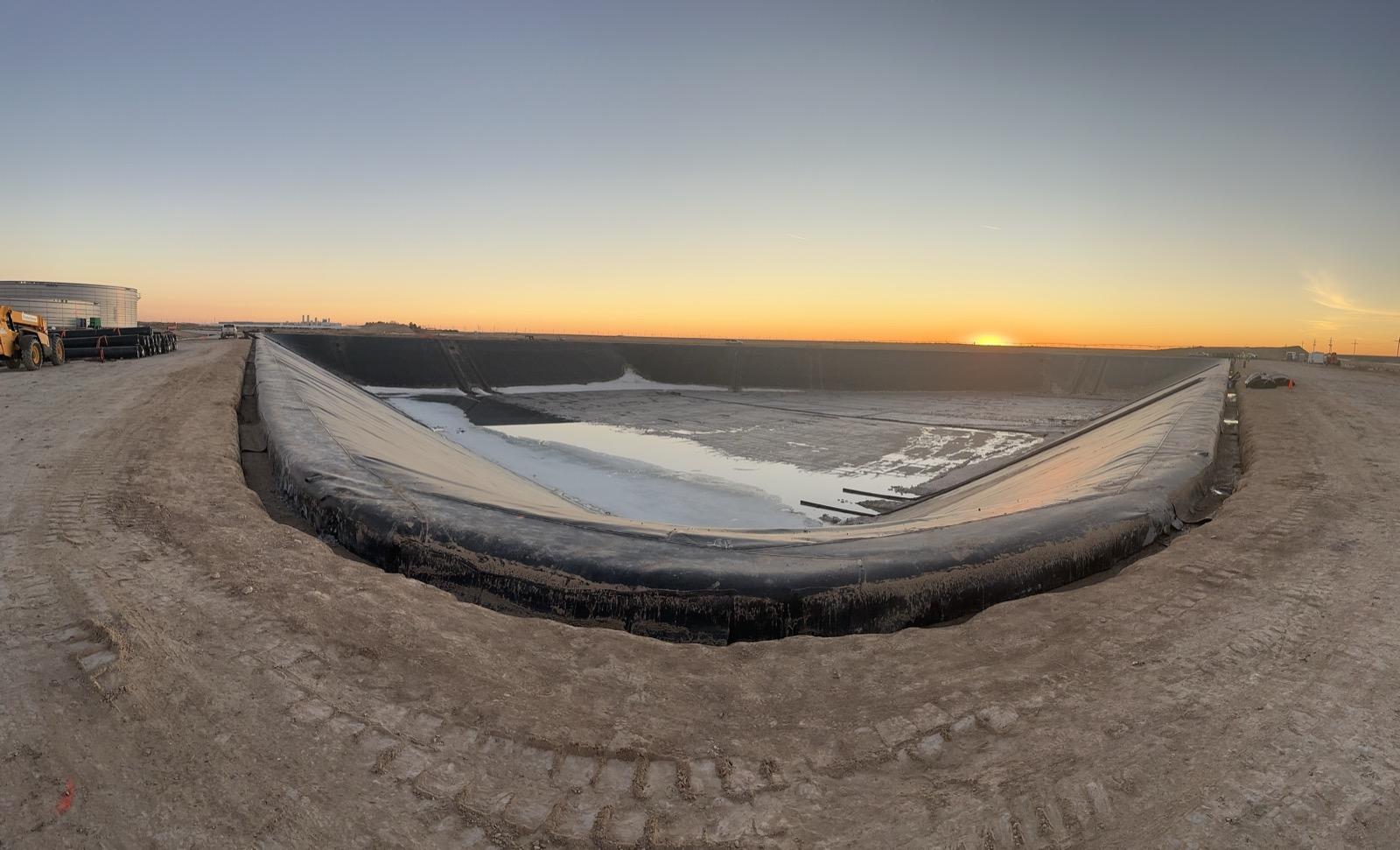
Two wastewater lagoon jobs in EFI's case history files were built around aerators, and both carried the aerators into the liner design. At Massanutten Public Service Company in McGaheysville, Virginia, EFI fitted 149,000 square feet of 60 mil smooth HDPE around deeper aerator pits. At the Town of Arlington, Tennessee, EFI lined a 328,000 square foot sludge storage lagoon with 60 mil textured HDPE.
Neither record is long. Between them, they show what a liner crew has to plan for when mechanical equipment is going to run inside the basin it is lining.
Massanutten: a shallow pond with deep spots
Massanutten needed an overflow pond to hold peak flows during a wastewater treatment plant upgrade. Soil conditions limited how deep the pond could go. The design included deeper excavations at the aerator locations.
That left the liner with a floor that was not flat. EFI custom fitted the 60 mil smooth HDPE down into each aerator area, at depths that varied from one location to the next. Concrete pads were then placed over the liner in those areas. Robert G. Burgin, Jr., Inc. provided the process and civil design, and the case history dates the installation to October 2005.
The job also called for 130,000 square feet of 8 oz. nonwoven geotextile alongside the 149,000 square feet of liner. The record lists both quantities but does not map where the geotextile went, so this article does not guess.
Arlington: 7.5 acres under aerated sludge
Fisher & Arnold, Inc. designed Arlington's new wastewater treatment plant with a sludge storage lagoon fed from the plant's SBR building. The lagoon used aerators for treatment. The design specified 60 mil textured HDPE.
EFI performed the geomembrane installation. The original case history, dated September 2006, records 328,000 square feet of sheet, about 7.5 acres by straight conversion. Work started in late summer and finished on schedule.
For scale, Arlington's liner was a little over twice the Massanutten liner. Both used the same thickness. They differed in surface: smooth sheet in Virginia, textured sheet in Tennessee.
Where the equipment meets the sheet
In a lined basin, the liner is a continuous welded membrane, and anything that changes the floor, sits on the floor or ties into the slope becomes a detail the panel layout has to carry.
Massanutten shows two of those details in one job. The deeper aerator pits meant fitting sheet into local low points instead of rolling it across a flat floor. The concrete pads meant something heavy and rigid would rest on the finished liner. The record does not say what the pads were designed to do. Pads under aerators are a familiar detail on aerated basins, where they take turbulence and load that would otherwise reach the bottom.
Arlington's record is shorter on detail. It names the aerators and the textured sheet, and that is enough to say the aerators were part of the basin the liner was built for. EFI's lagoon liner guidance makes the same point: include equipment locations and interfaces in the liner layout supplied for review.
Smooth or textured
Texturing roughens the sheet surface to raise friction against soil and against other layers. Neither case history explains why its engineer picked smooth or textured sheet, and the choice belongs to the design engineer of record.
EFI's HDPE geomembrane specification lists 60 mil as the most commonly specified thickness and names municipal wastewater lagoons among its typical uses. Both of these jobs sit in that row of the table.
What the installation spec asks for
Fitting sheet into pits and under pads does not relax the installation rules. EFI's HDPE specification page sets the baseline for any lagoon liner:
- Subgrade smooth, free of rocks larger than half an inch and compacted to 95 percent Proctor.
- No welding during precipitation or on wet surfaces, and welding at ambient temperatures of 40°F or higher.
- Trial welds at the start of each shift and every four hours.
- Air channel testing of dual track seams at 25 to 30 psi for at least five minutes.
- Destructive peel and shear testing per ASTM D6392.
Pits and pads add seams, corners and patches in a small area. Those are the places where the testing plan earns its keep, so the closeout record should show them clearly.
Questions to settle before the panel layout
Both records describe work that followed an engineer's design. An owner or engineer planning an aerated lagoon can give the liner contractor a better start by answering these first:
- Where will each aerator sit, and does any location need a deeper pit or a different floor elevation?
- Will concrete, ballast or equipment rest on the liner, and what goes between the sheet and that load?
- How are aerators moored or powered, and do cables, anchors or posts cross the slope or the anchor trench?
- Is the sheet smooth or textured, and has the engineer of record set that for the slopes and layers involved?
- Where will geotextile go, and is it a cushion, a separator or both?
- Which seams, patches and penetrations will the closeout record need to show, and who witnesses the tests?
What this means for an owner
An aerator is usually bought as process equipment and a liner as civil work. In a lined basin they meet at the floor, and the easiest time to resolve that meeting is on the drawings, before panels are cut.
EFI USA has fabricated and installed geomembrane systems from Gaston, South Carolina since 1993, with more than 30 years in geosynthetics. Its work runs from wastewater lagoon liners like Massanutten and Arlington to floating covers and covered lagoon digesters, where EFI accounts for roughly 82 percent of the US covered lagoon digester market.
If an aerated lagoon is on your schedule, send EFI the basin plan, the aerator layout and the liner specification. The fit around the equipment can then be worked out before the first roll is deployed.